Kaw Mission State Historic Site

Visited on: Wednesday, October 11, 2023
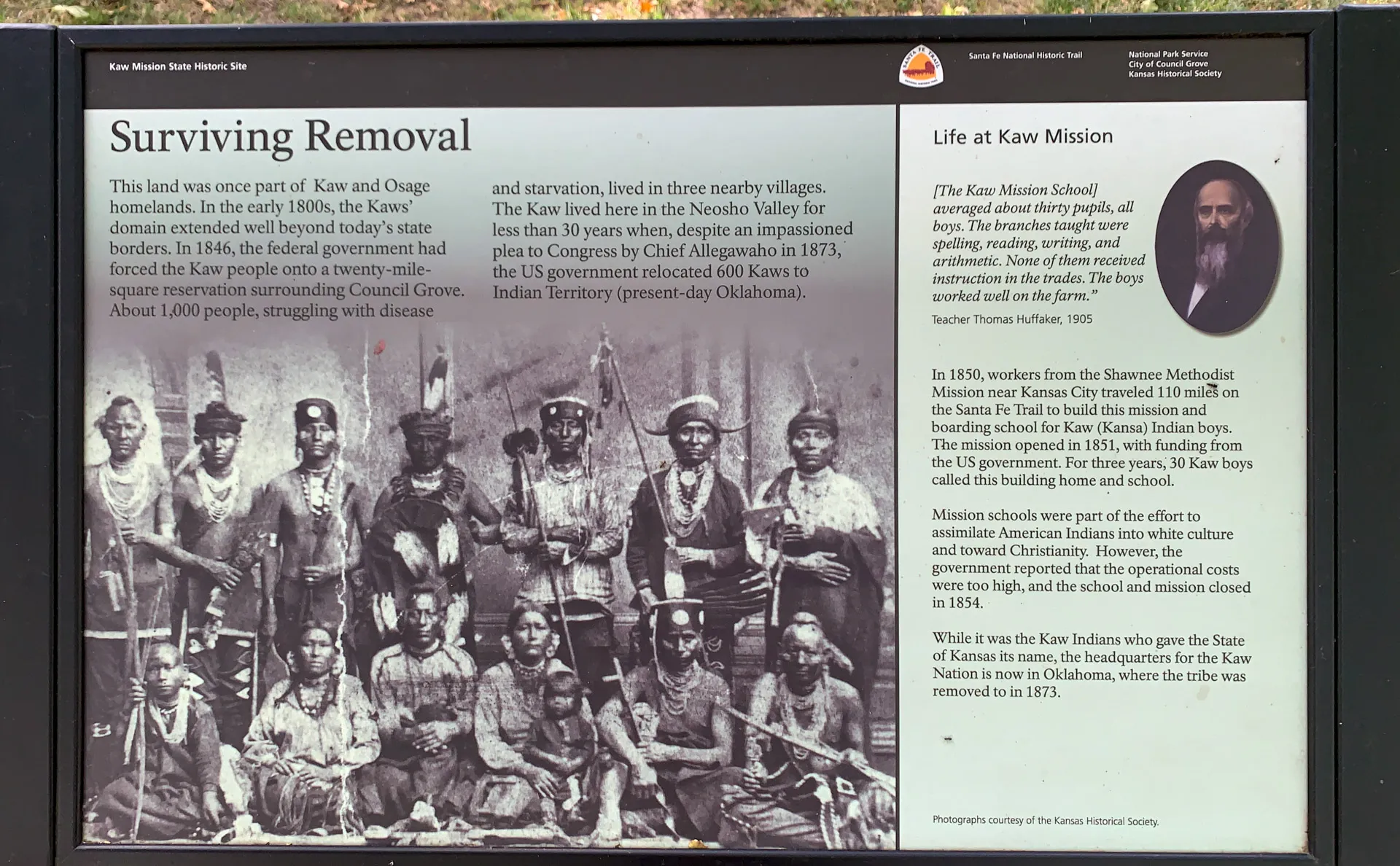
Informational display titled "Surviving Removal" and "Life at Kaw Mission" featuring text about Kaw history, a photo of Kaw individuals in traditional attire from circa 1870, and an image of the Kaw Mission School. A portrait of a man related to the school is included.

Located in Council Grove, Kansas, the Kaw Mission State Historic Site offers a unique glimpse into the crossroads of American history. This site is significant not only for its architectural charm but also for its historical importance as a place where different cultures intersect. Built-in 1851, the mission served as a school for boys from the Kaw (or Kansa) tribe, marking a period of cultural exchange and adaptation during a time of significant change on the American frontier.

When you visit the Kaw Mission, you’ll step into a well-preserved building that tells the story of these young Kaw boys and their experiences as they navigated the pressures of assimilation into European-American society. The mission itself is made of native limestone, showcasing the local materials and craftsmanship of the mid-19th century. Inside, exhibits provide insights into the lives of the students, their families, and the broader context of Native American education policies at the time. You’ll find artifacts, photographs, and informative displays that bring this complex history to life.
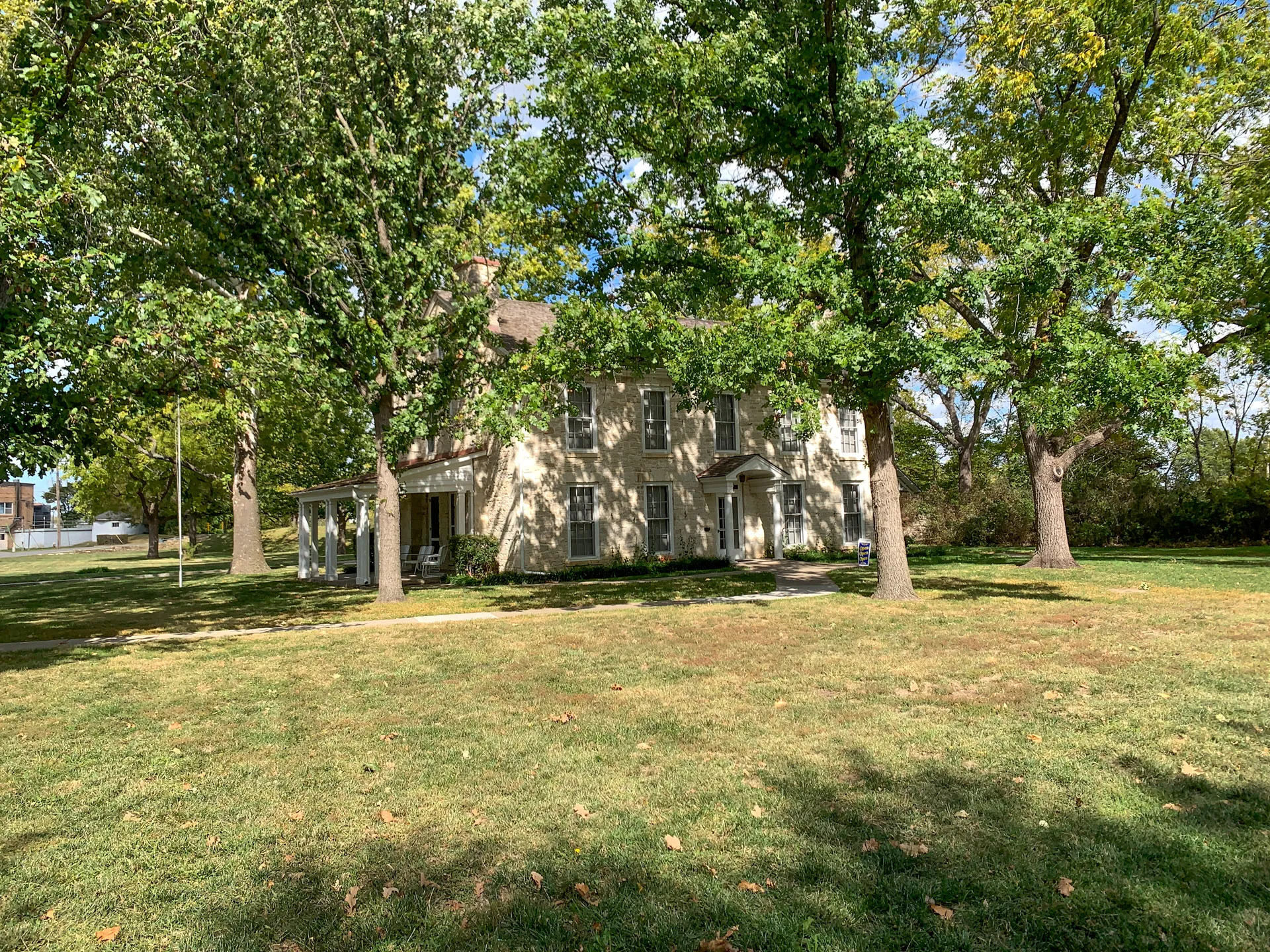
A two-story beige house with white trim is partially obscured by large trees in a grassy area. The trees are lush with green leaves, casting gentle shadows on the lawn and house. A clear blue sky is visible in the background, providing a serene and sunny atmosphere.
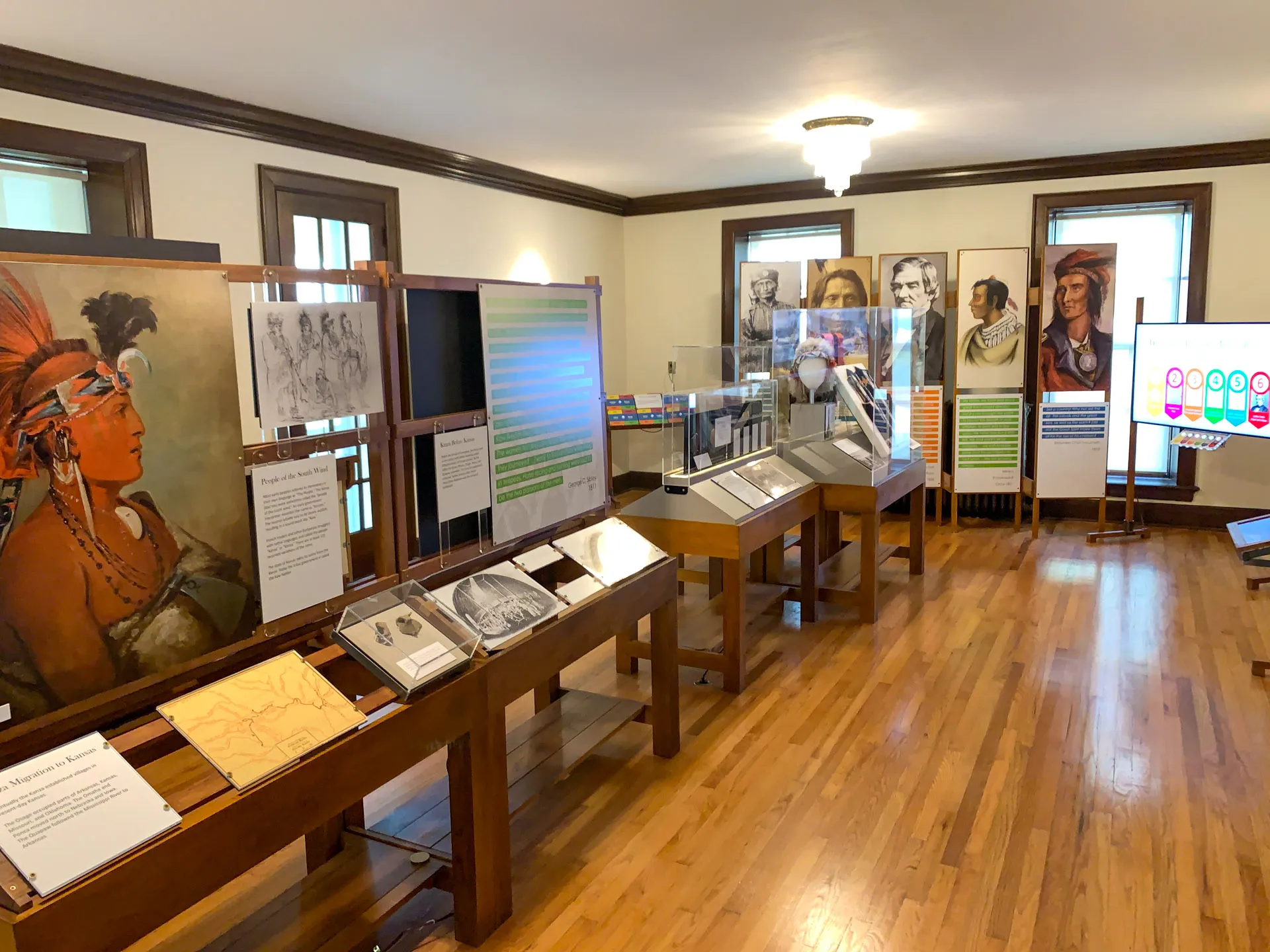
A museum exhibit room with wooden floors and a variety of displays. Art panels and information boards are arranged neatly, showcasing historical illustrations and artifacts. A digital screen displays colorful graphs. The walls are lined with large portraits and windows.
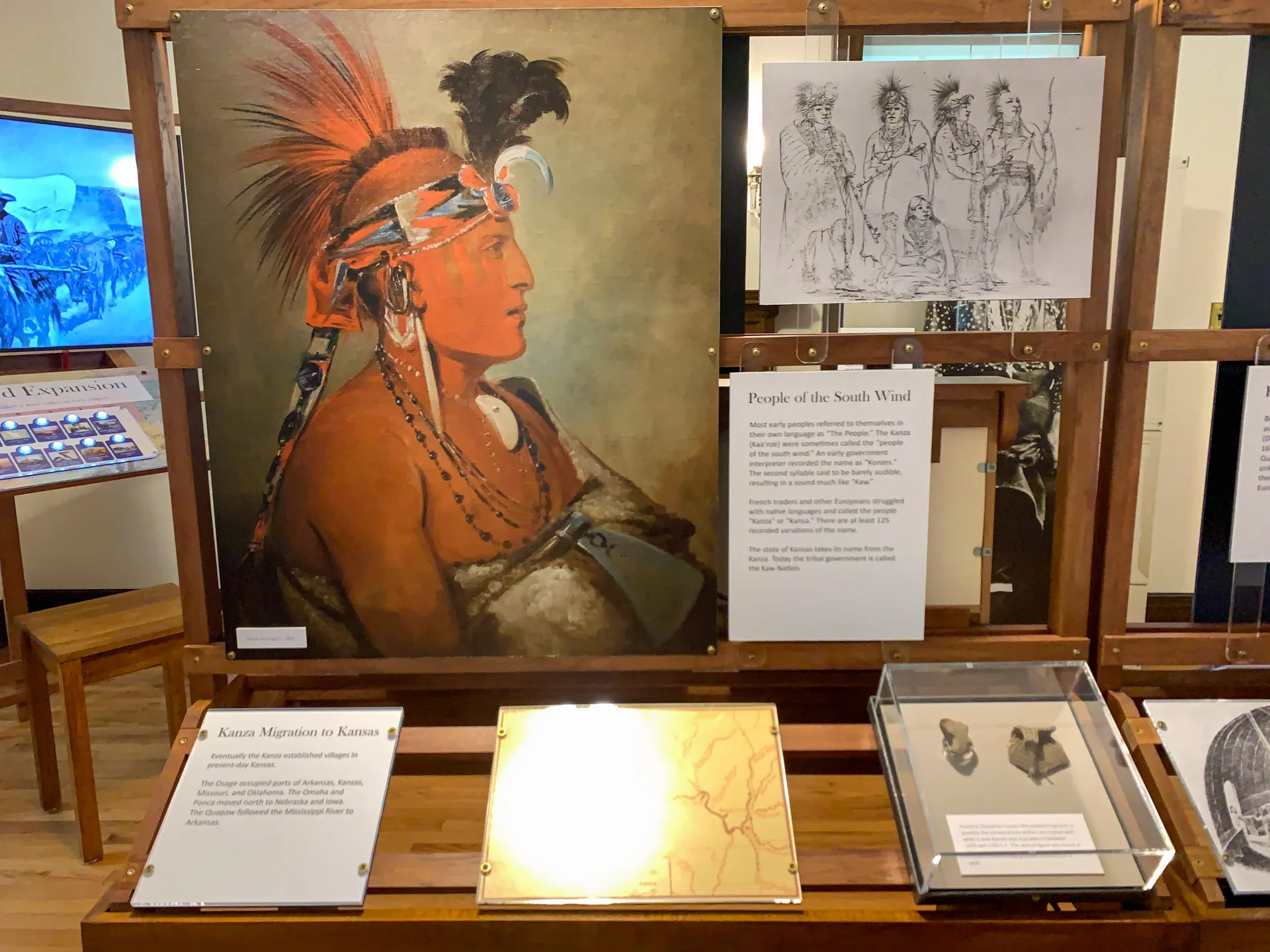
A museum display showcasing a portrait of a Native American man with traditional attire, surrounded by artifacts and descriptions. To the right, a historical sketch and text panel titled "People of the South Wind" are visible. Below are an open book, a map, and small artifacts in glass cases.
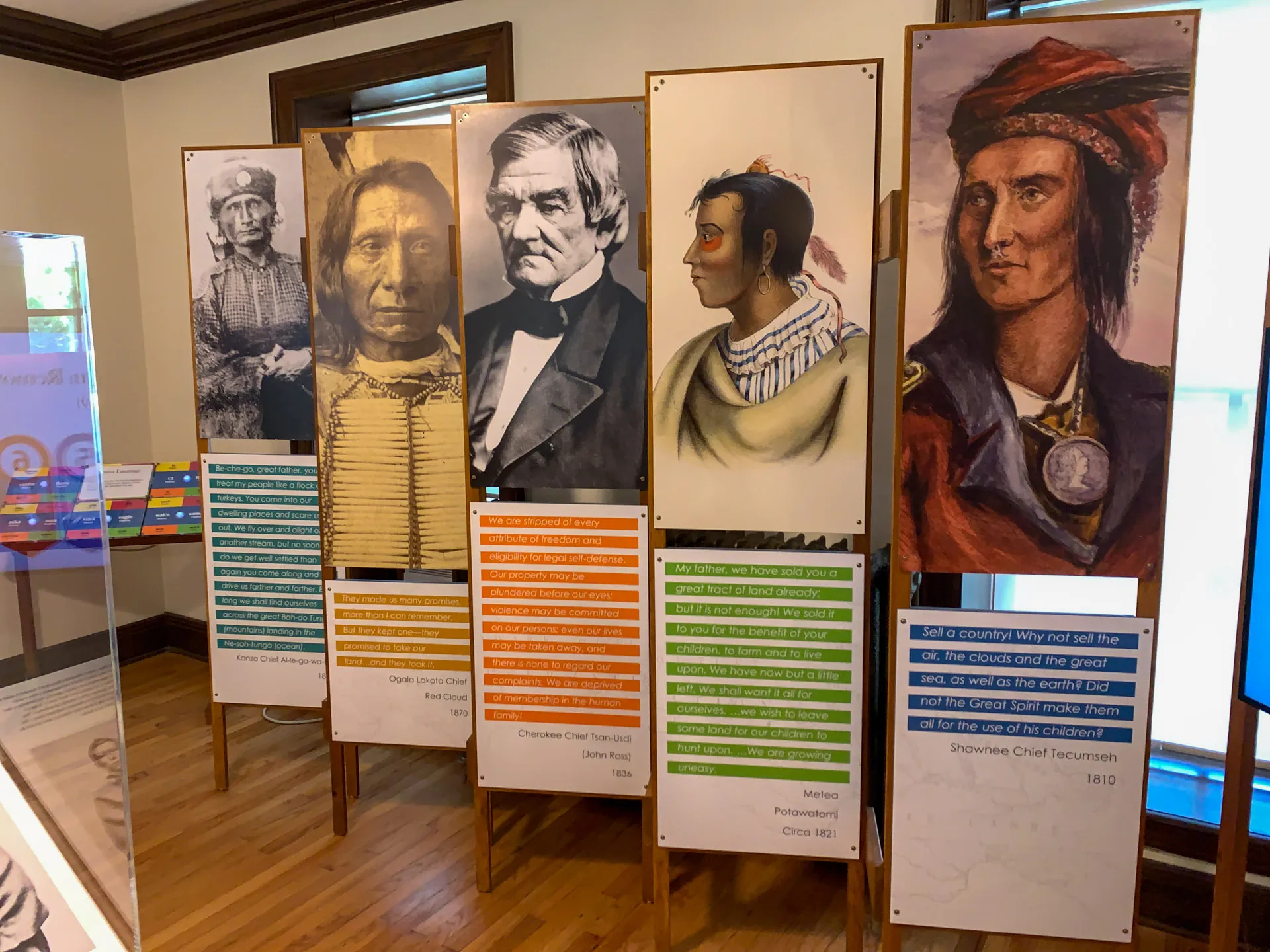
Exhibit showcasing five portraits of Native American and historical figures on standees. Below each portrait, there are colored panels with text about treaties and historical events. The display is set in a room with wooden floors and white walls.
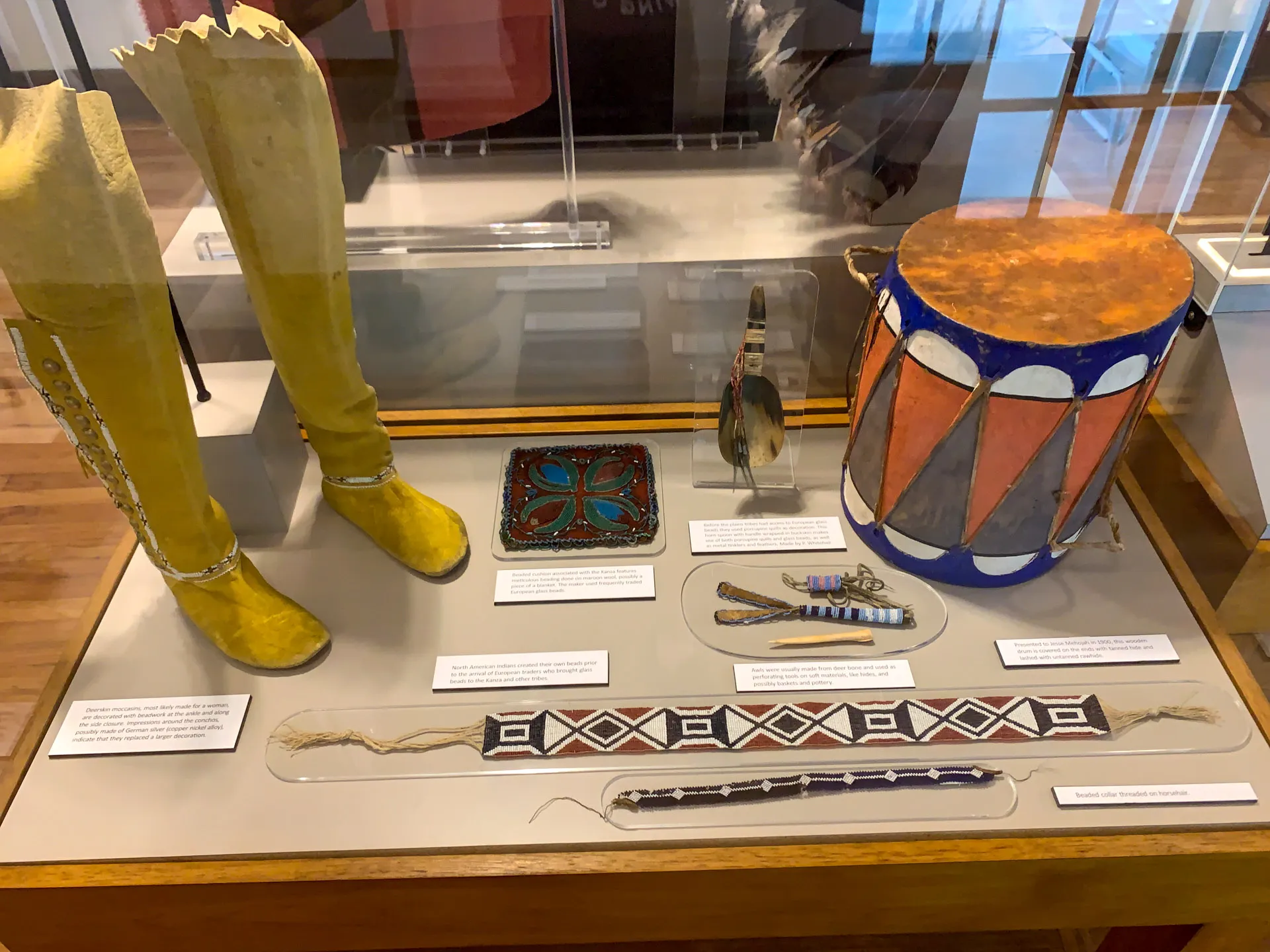
Display case featuring indigenous artifacts: yellow moccasins, a feather, a colorful beaded square, a drum with blue and orange patterns, and intricately beaded belts. Each item has a descriptive label. Wood-framed glass case with a brown floor.
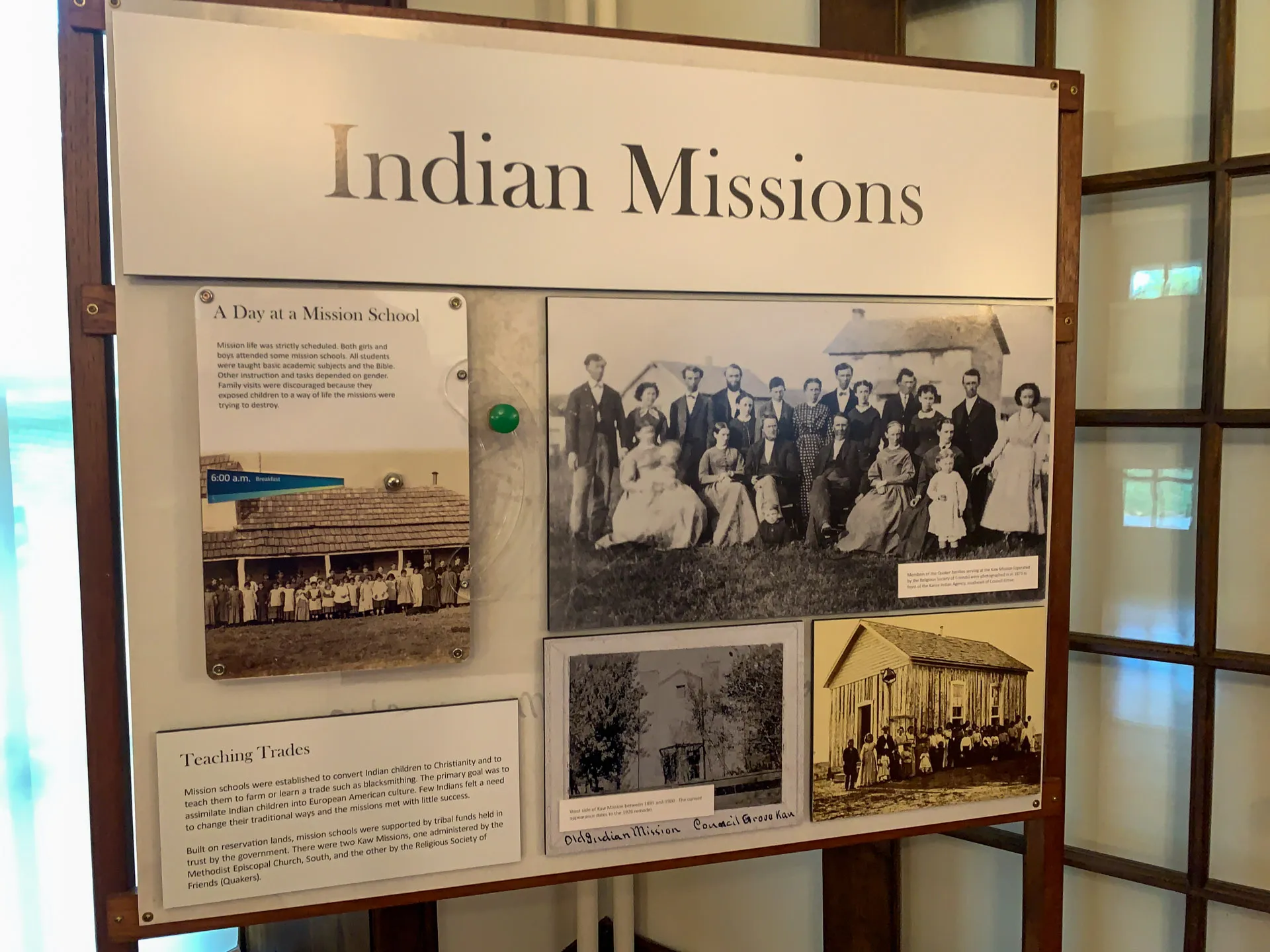
A display board titled "Indian Missions" features historical photos and text. One old photo shows a group of people, another depicts a mission building. Text on the board describes daily life and teaching trades at mission schools. The setting appears to be indoors, in a museum or exhibit space.
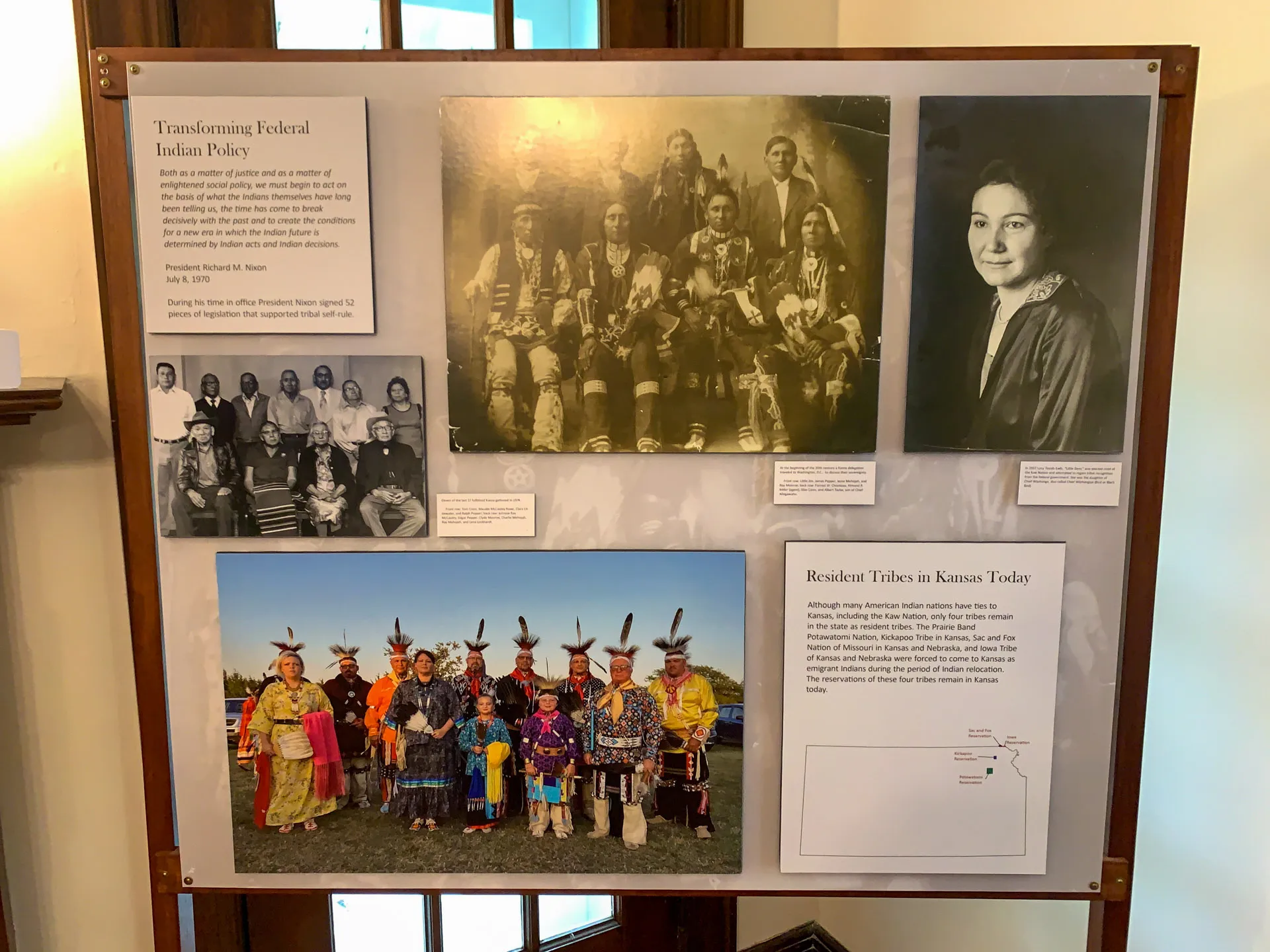
Display board featuring historical and contemporary images of Indigenous people. Top left: federal policy info with a black-and-white group photo. Top right: portrait of a woman. Bottom: colorful photo of tribal members in regalia with text about Kansas tribes today.
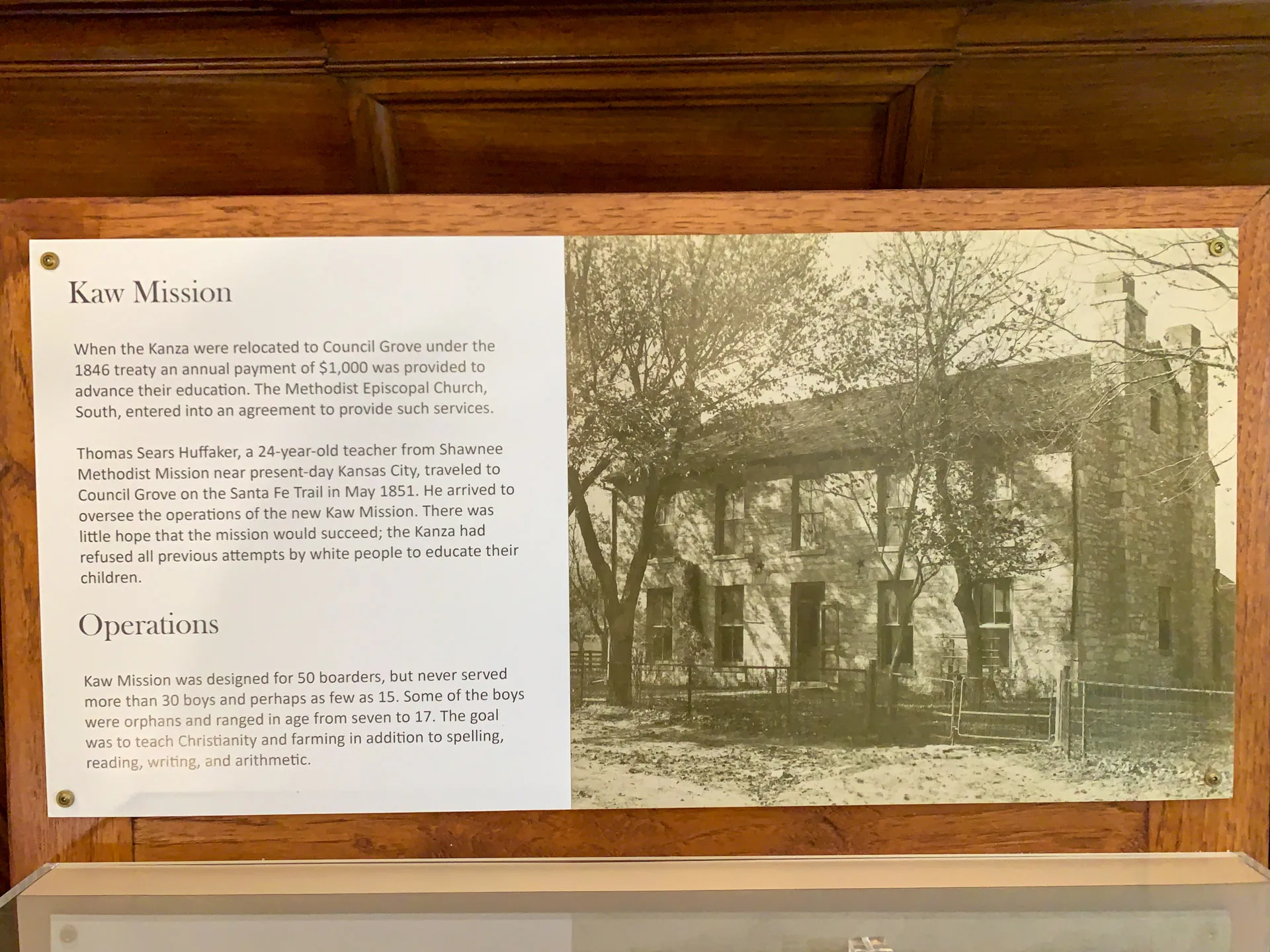
A display with a historical photograph of Kaw Mission, featuring an old building surrounded by trees. The text describes the arrival of Thomas Sears Huffaker in 1851 and the operations of the Kaw Mission, which educated Native American boys. The sign provides details on the mission's history and function.
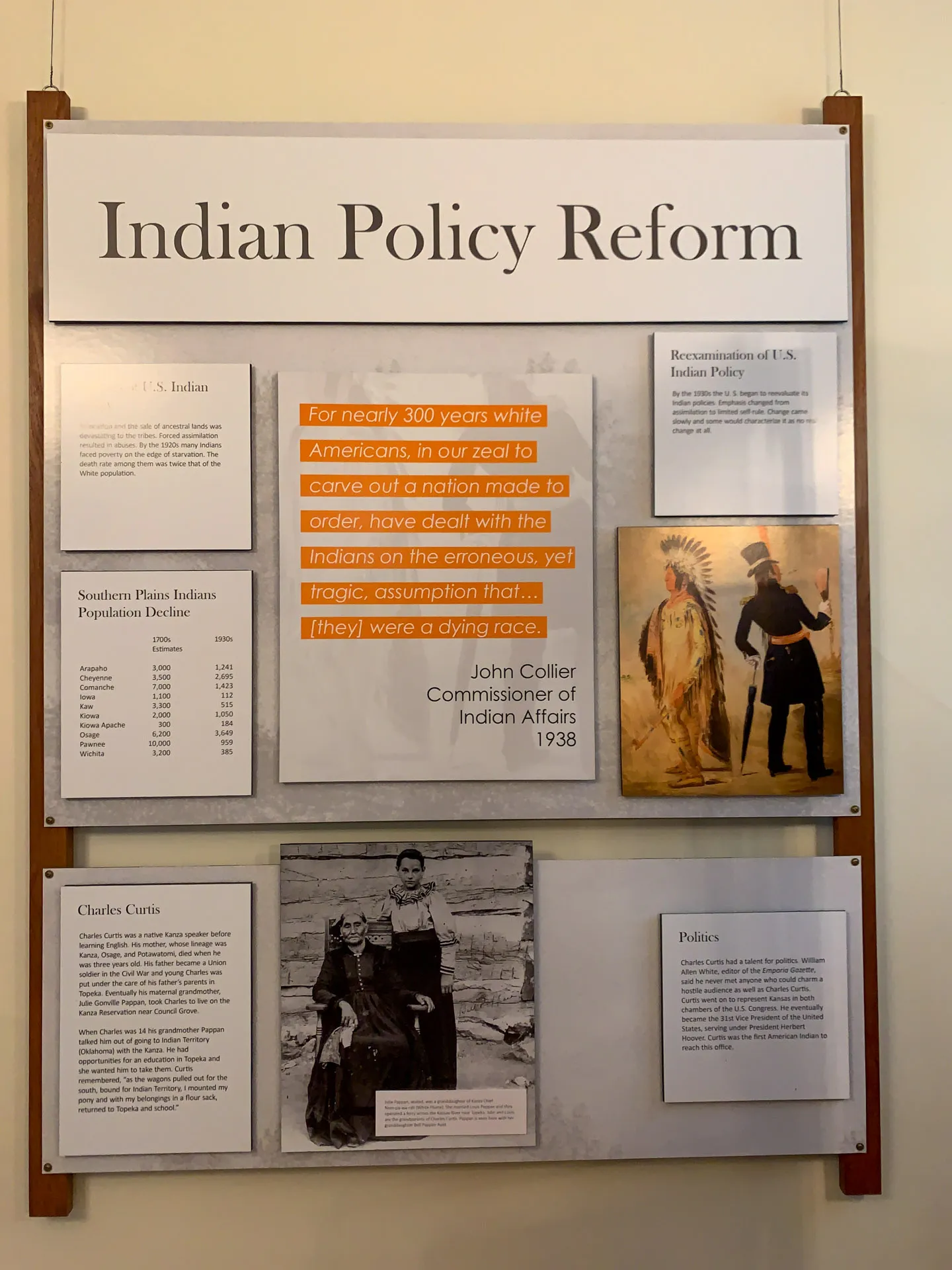
Exhibit panel titled "Indian Policy Reform" featuring historical text, images, and charts. Highlights include a quote from John Collier (1938), a photo of a Native American in traditional attire, a depiction of a man. Contains information about Southern Plains Indian populations.
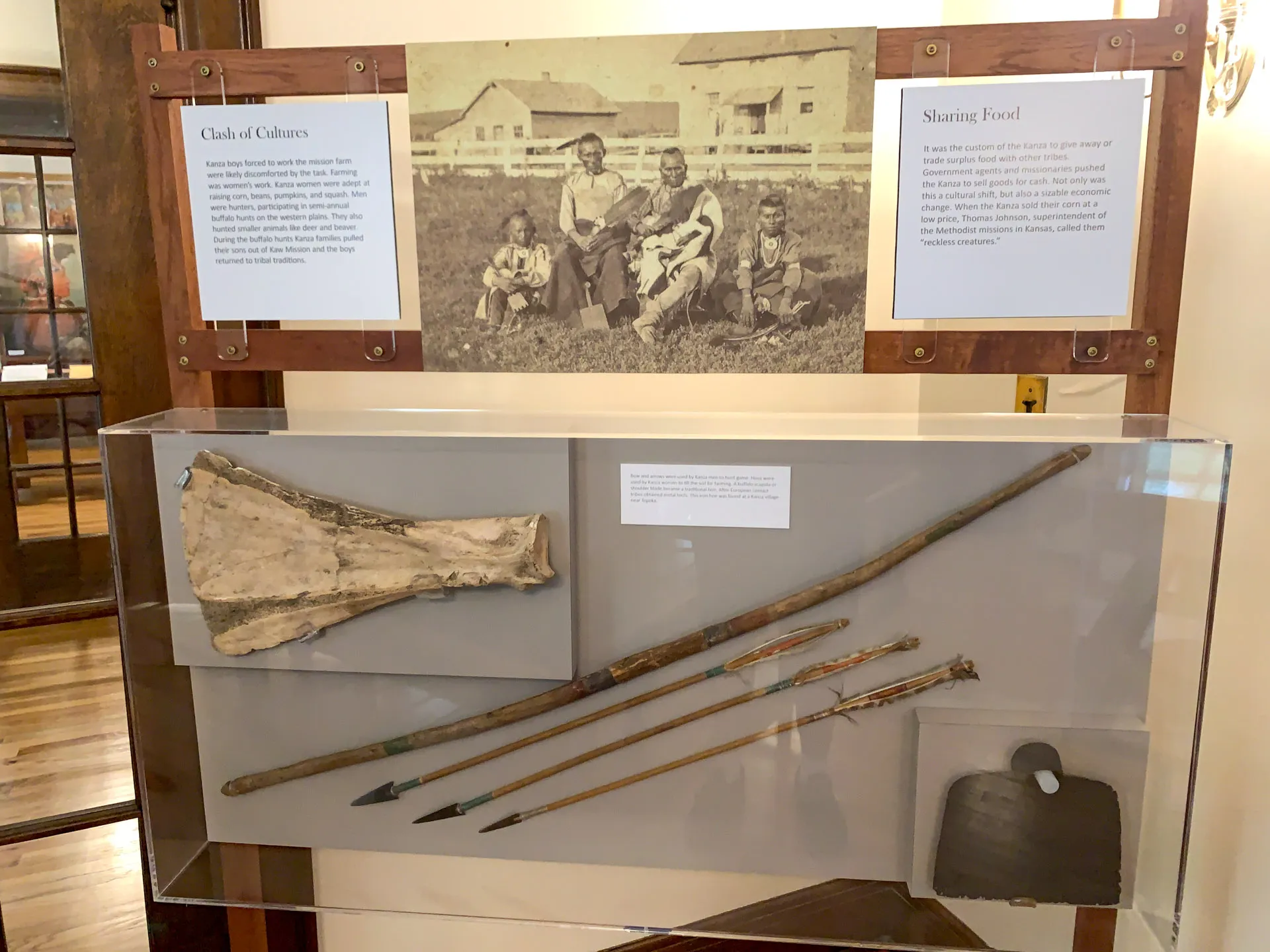
A museum exhibit displays a photo of several people sitting on grass near a wooden fence, titled "Clash of Cultures" and "Sharing Food." Below, a case contains large bones, spears with metal tips, and an iron cooking tool, suggesting historical artifacts of cultural interaction.
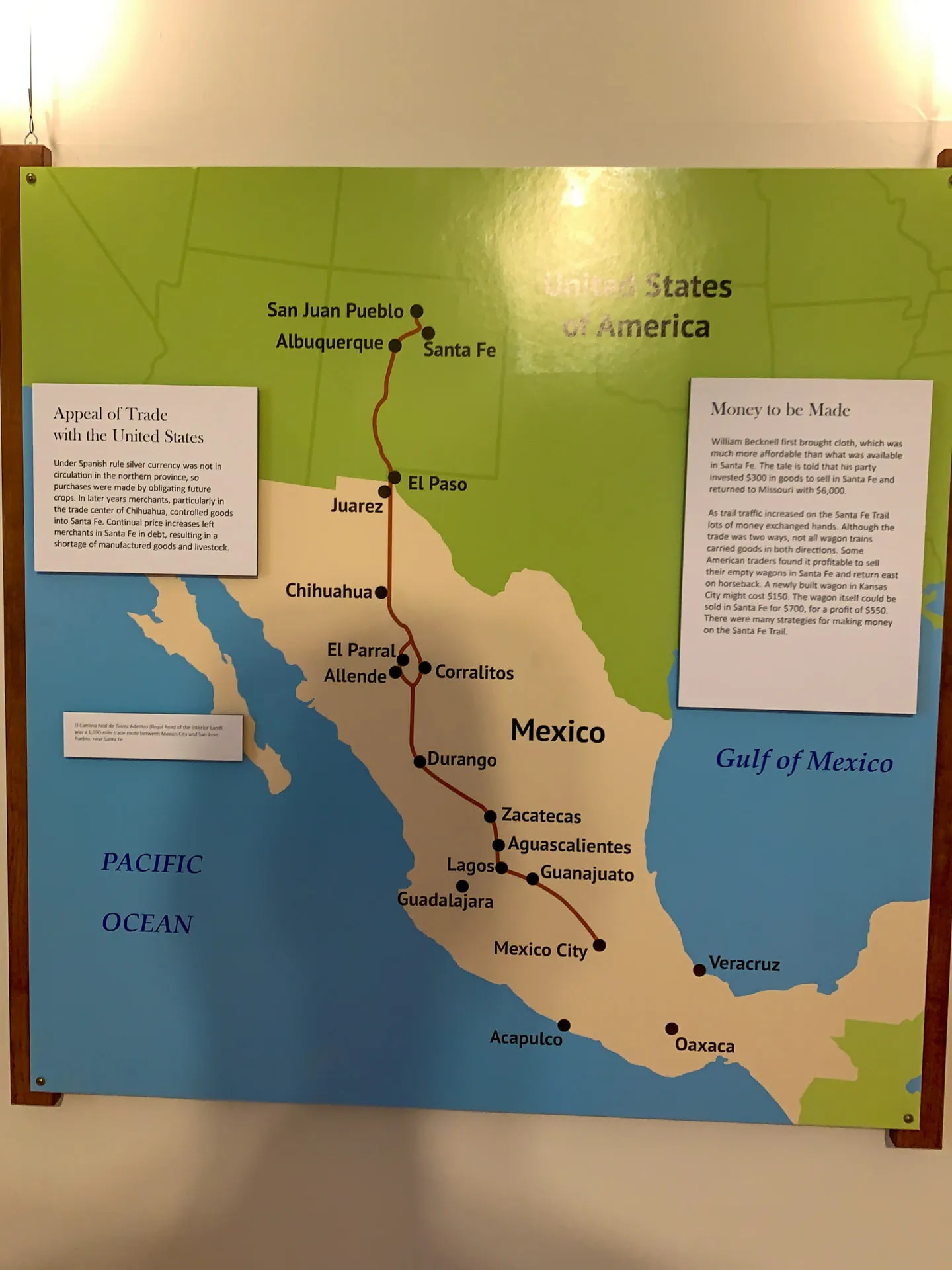
Map illustrating a trade route from Mexico to the United States with stops in major cities like Mexico City, Durango, and Albuquerque. Text boxes titled "Appeal of Trade with the United States" and "Money to be Made" highlight historical trade benefits. Labels for oceans and countries included.
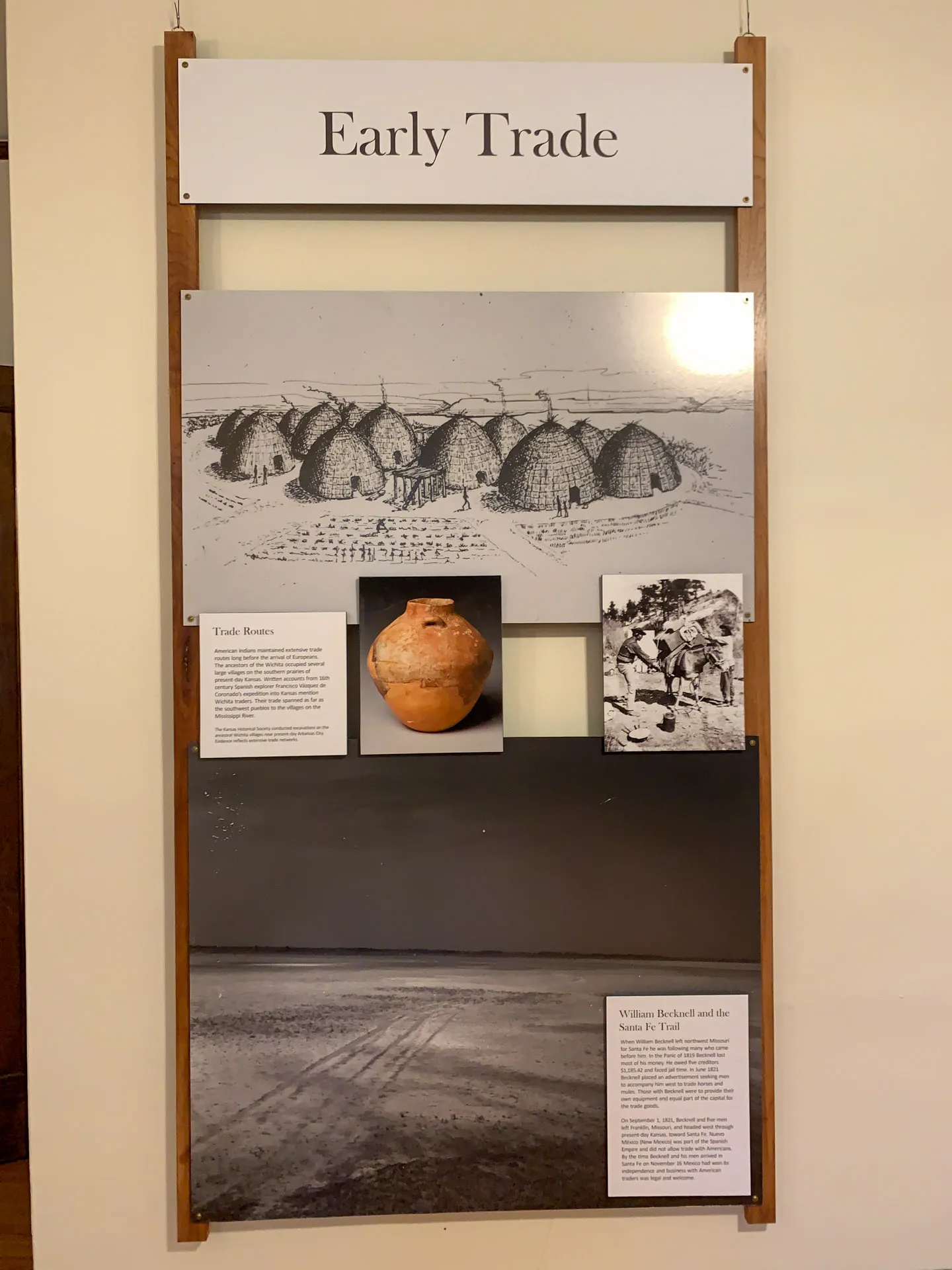
Museum exhibit titled "Early Trade" with images: top section shows drawings of round huts; middle section includes a clay pot and a historical photo of a market scene; bottom section depicts a landscape. Text panels provide context on trade routes and William Becknell’s role in local trade.
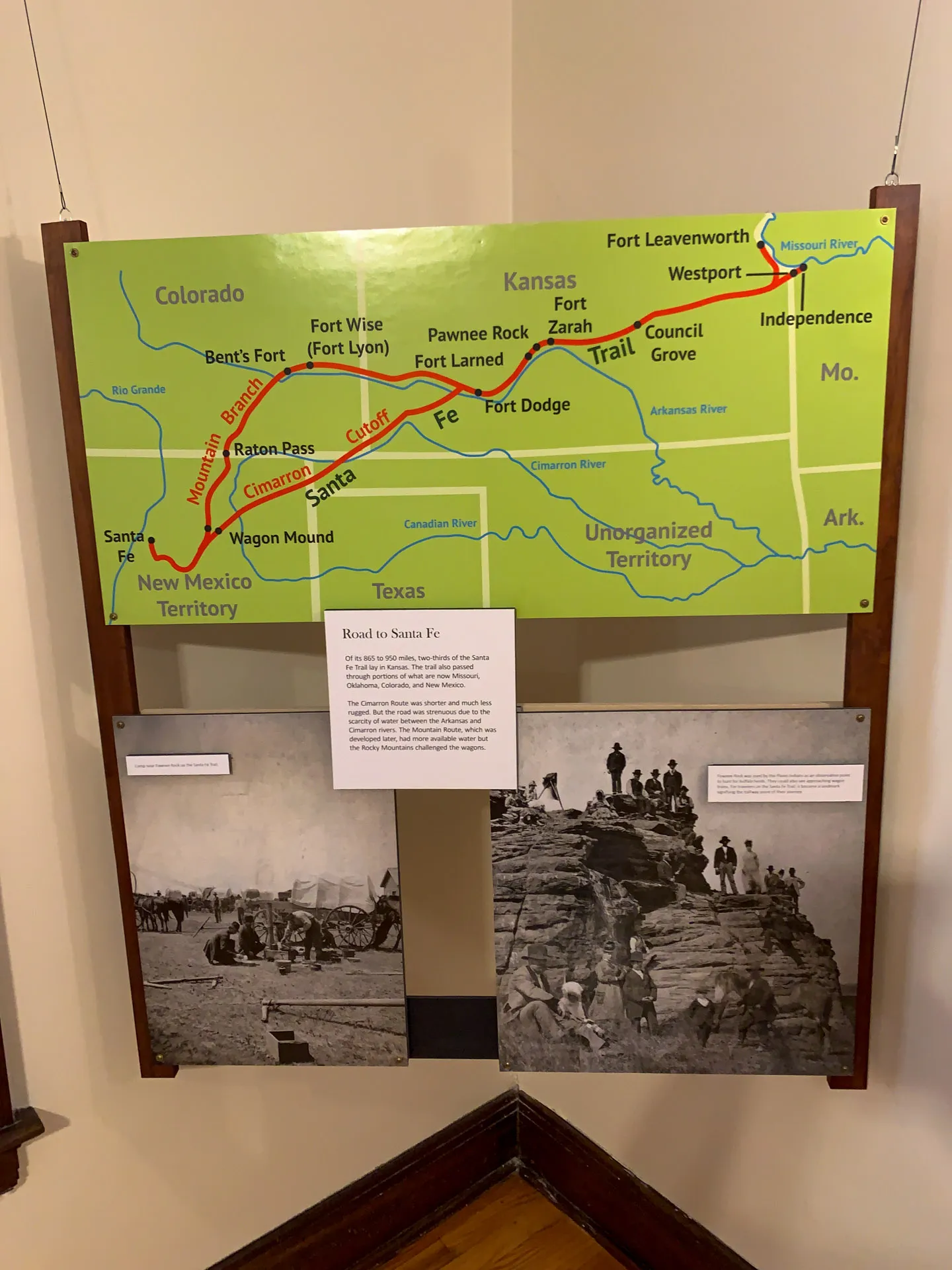
A museum display features a map highlighting the Santa Fe Trail, marking stops from Fort Leavenworth, Kansas, to Santa Fe, New Mexico, with a red line. Below the map are two historical photos: one of wagons and settlers, and another of people gathered on a rocky terrain.
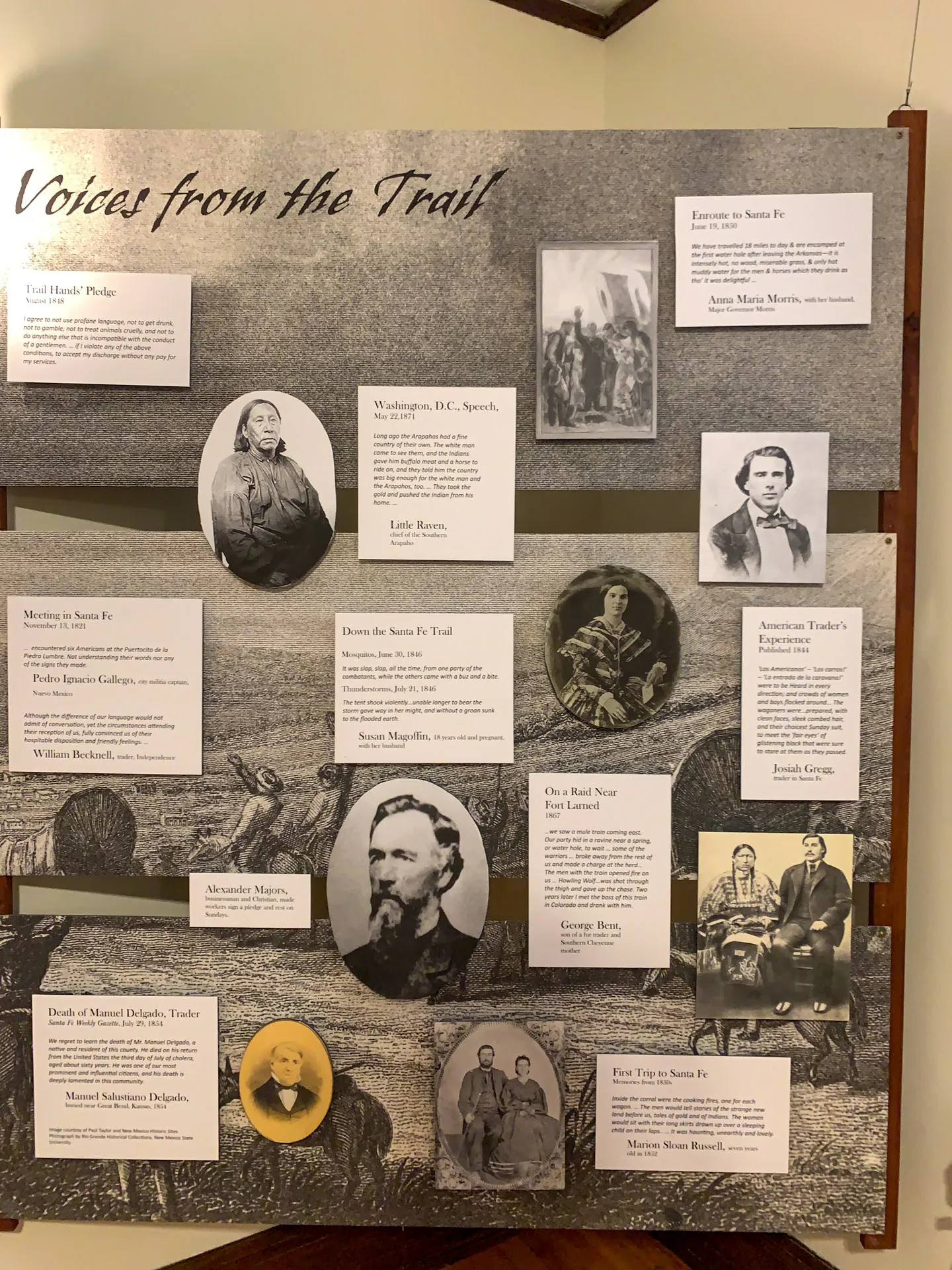
A display titled "Voices from the Trail" features portraits and text panels. It includes historical figures with descriptions of their contributions, events, and locations related to Santa Fe. The background has a vintage illustration of a western scene with horse-drawn wagons.
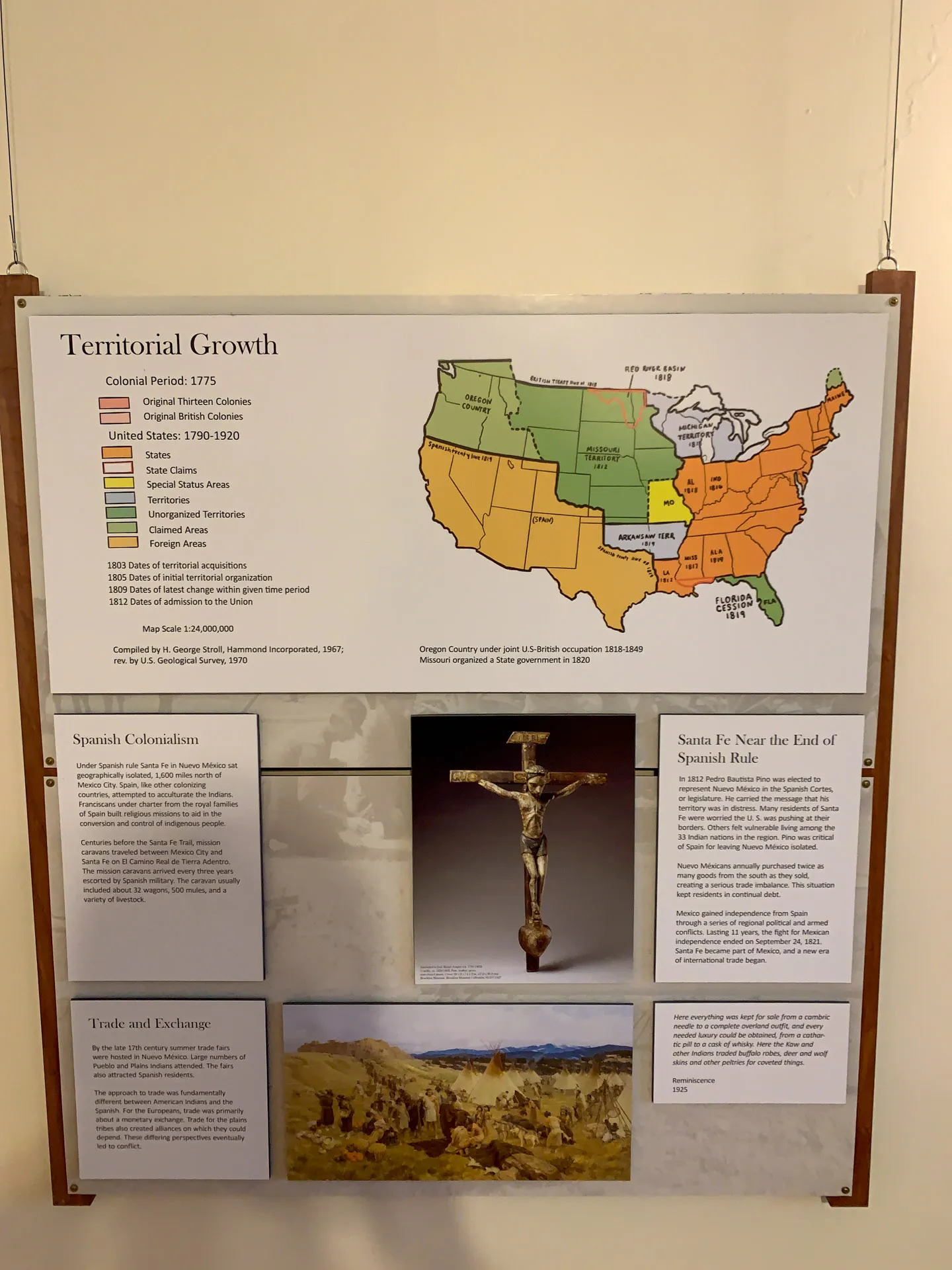
A historical display board shows a U.S. map illustrating territorial growth, color-coded by periods. Below are sections titled "Spanish Colonization," featuring text and an image of a cross, and "Trade and Exchange," with a desert landscape photo. The board hangs on a beige wall.
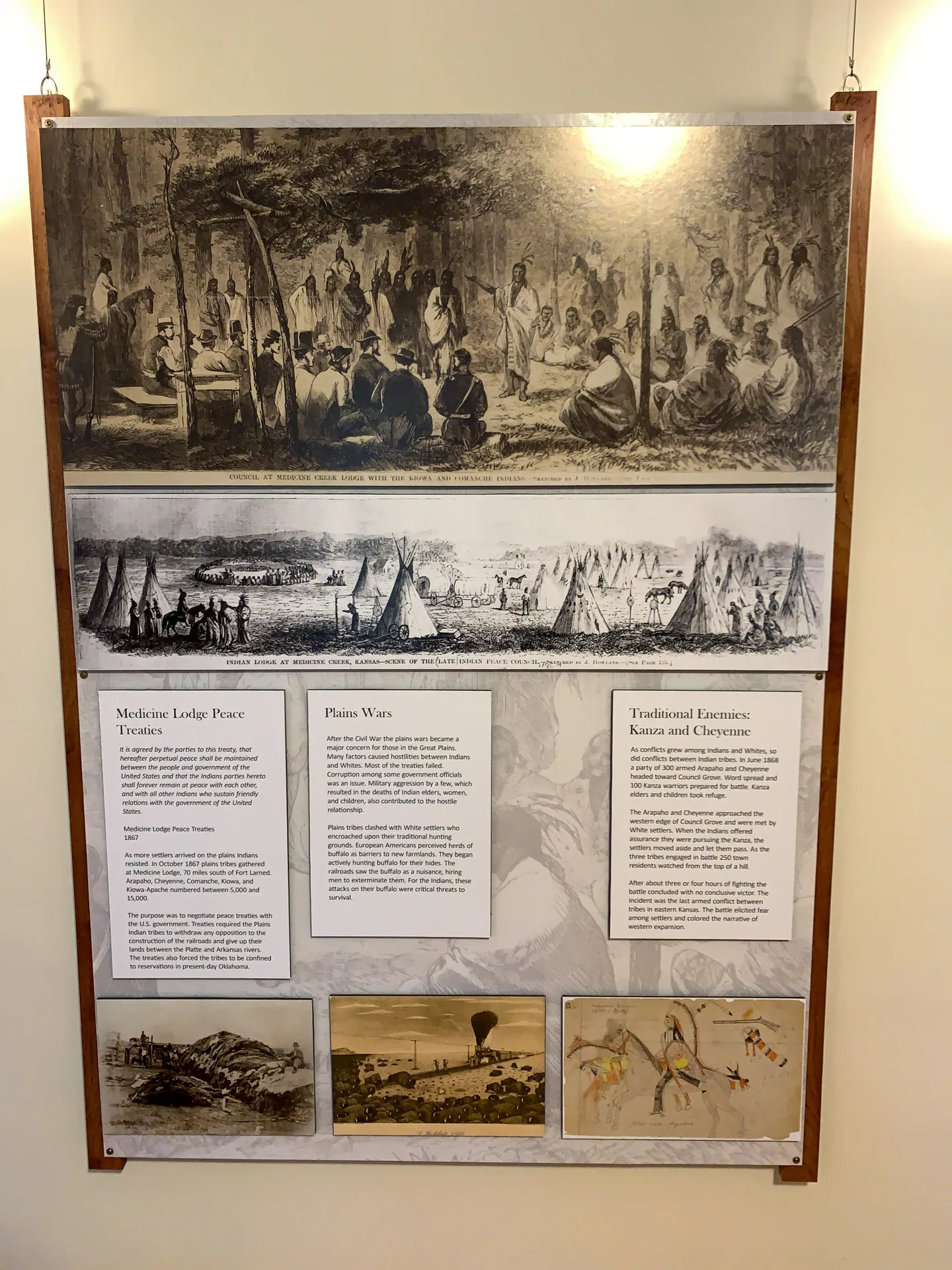
A display board featuring historical illustrations and text. The top section shows a group of people in a forest setting. Below are scenes with tents and figures, related to Medicine Lodge Peace, Plains Wars, and Tribal Traditions. Three more illustrations depict landscapes and activities.
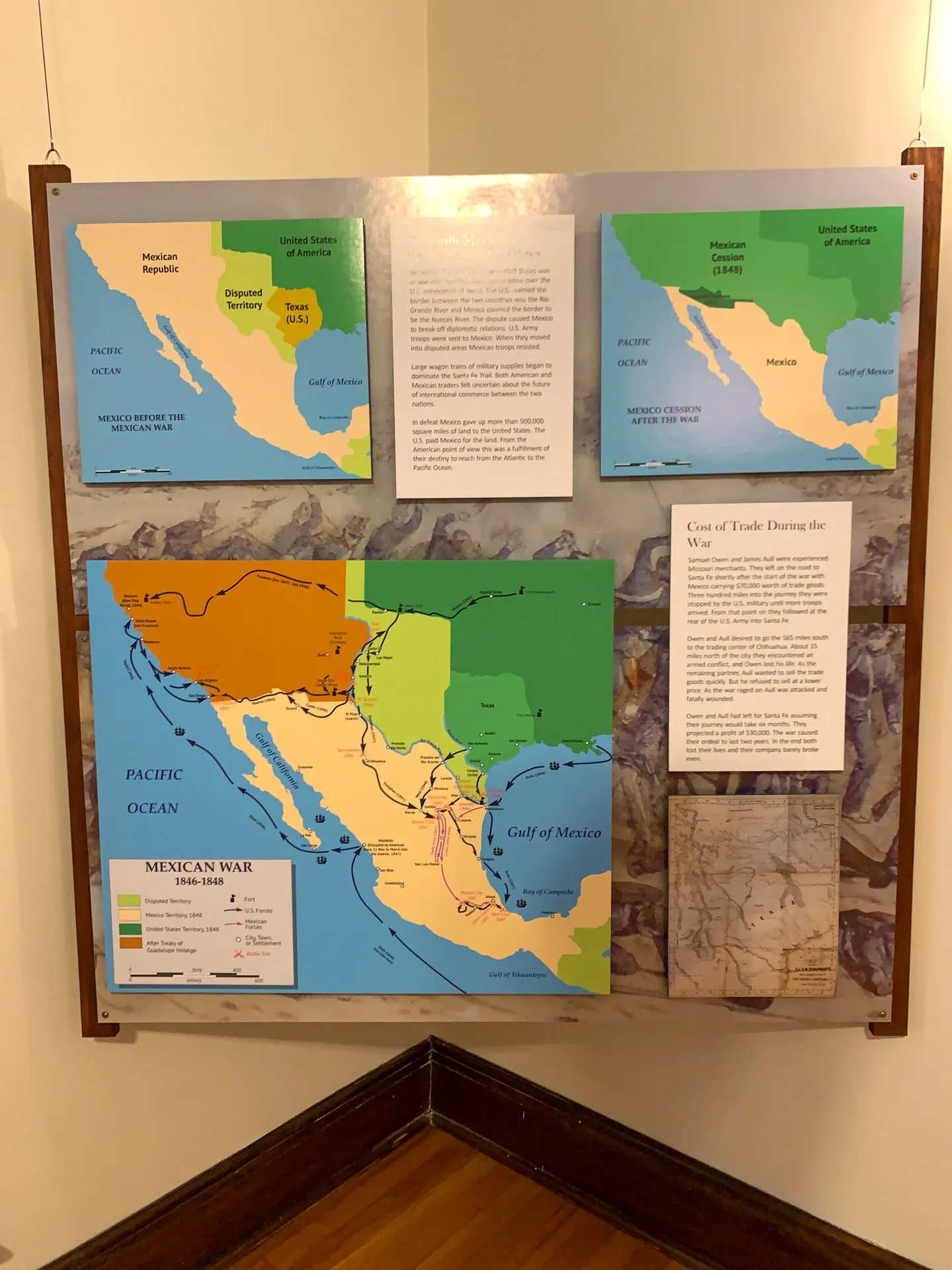
Exhibit of maps and text detailing the Mexican-American War. Includes colorful maps showing territorial changes and historical routes, a text box on trade costs, and descriptions. Wooden floor and cream-colored walls frame the display.
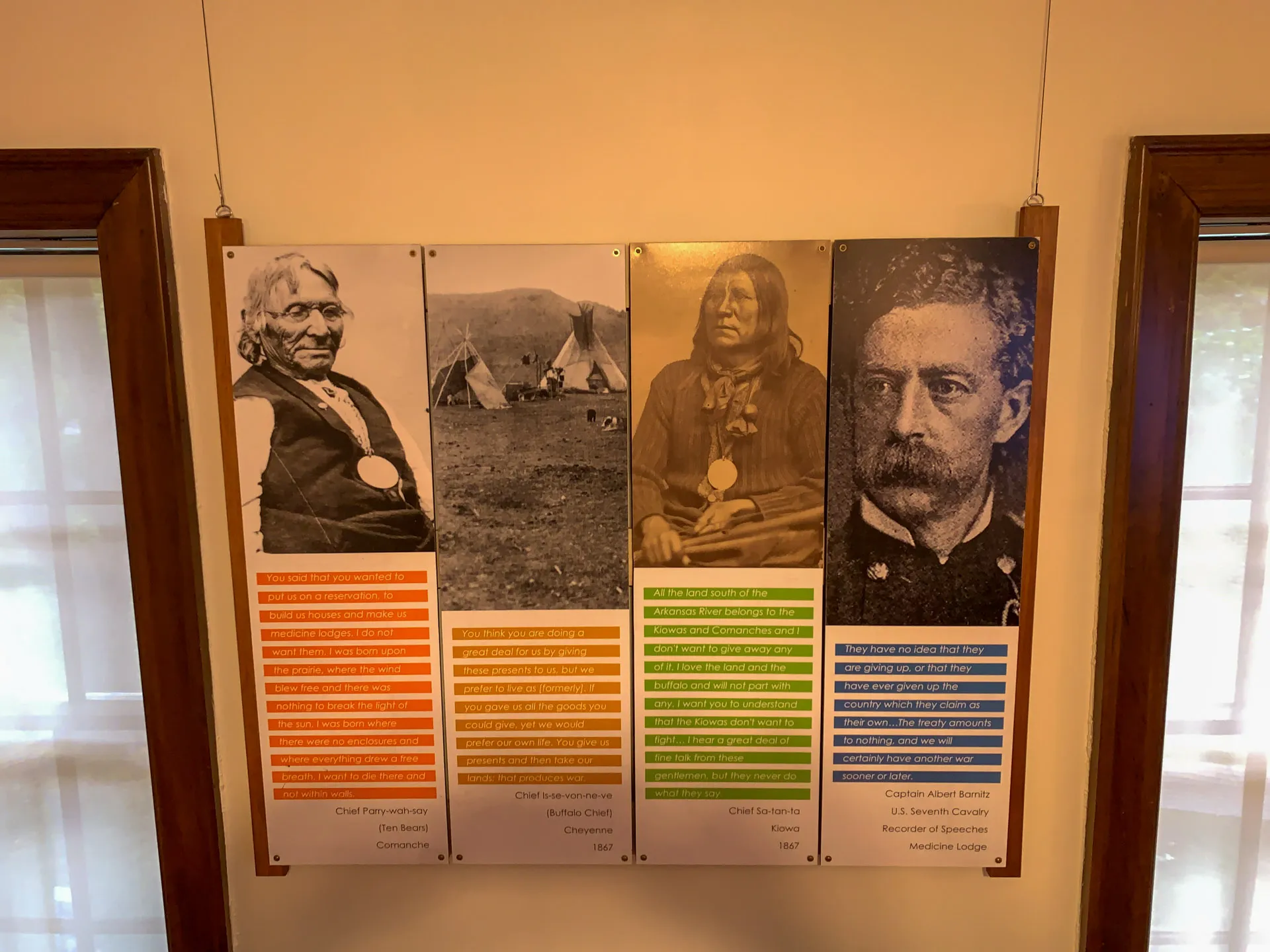
A museum display features four vertical panels with images and text. From left to right: portraits of Chief Plenty Coups, Buffalo Calf Road Woman, Chief Sam Sinquesip, and Captain Robert Snyder. Below each image is a biography and achievements highlighted in various colors.
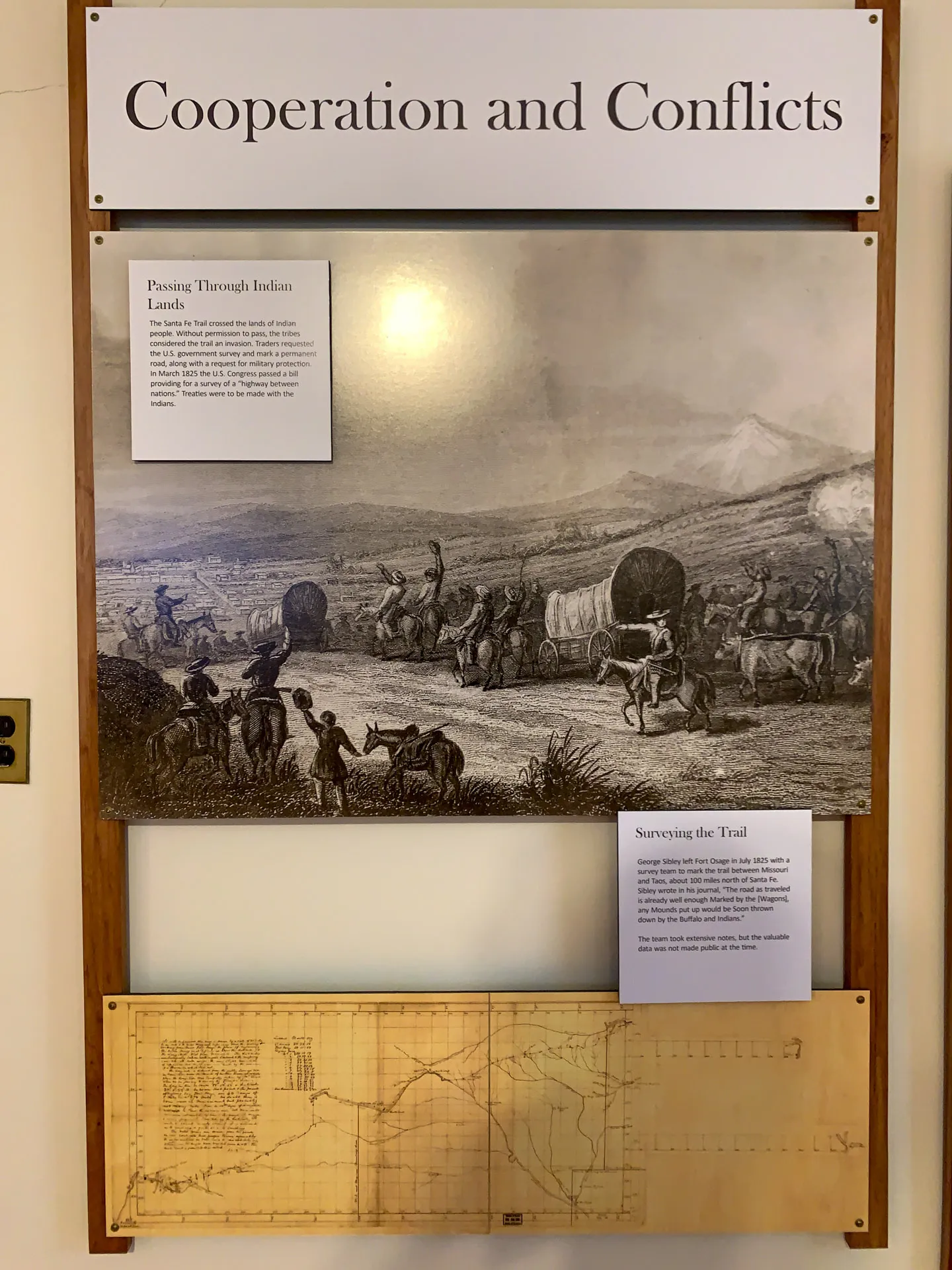
A museum display titled "Cooperation and Conflicts" features two framed sections. The top section shows an illustration of settlers with covered wagons crossing a landscape, with Native Americans observing. The bottom section contains a historical map. Text descriptions accompany both sections.
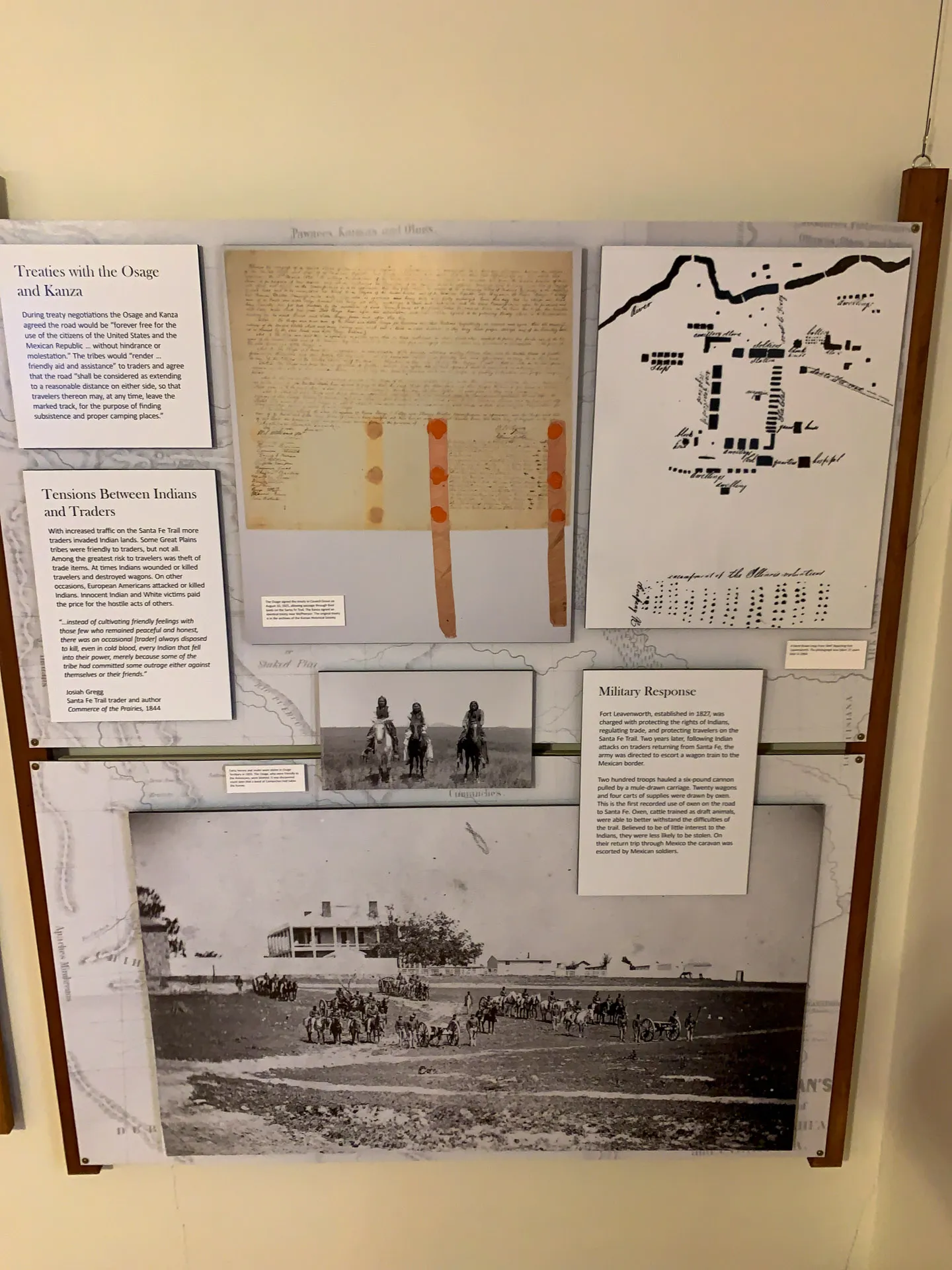
A museum display showcases historical documents and images. It includes a hand-drawn map, text panels titled "Treaties with the Osage and Kansa" and "Tensions Between Indians and Troops," a photo of Native American riders, and an image depicting a military fort with soldiers and horses.
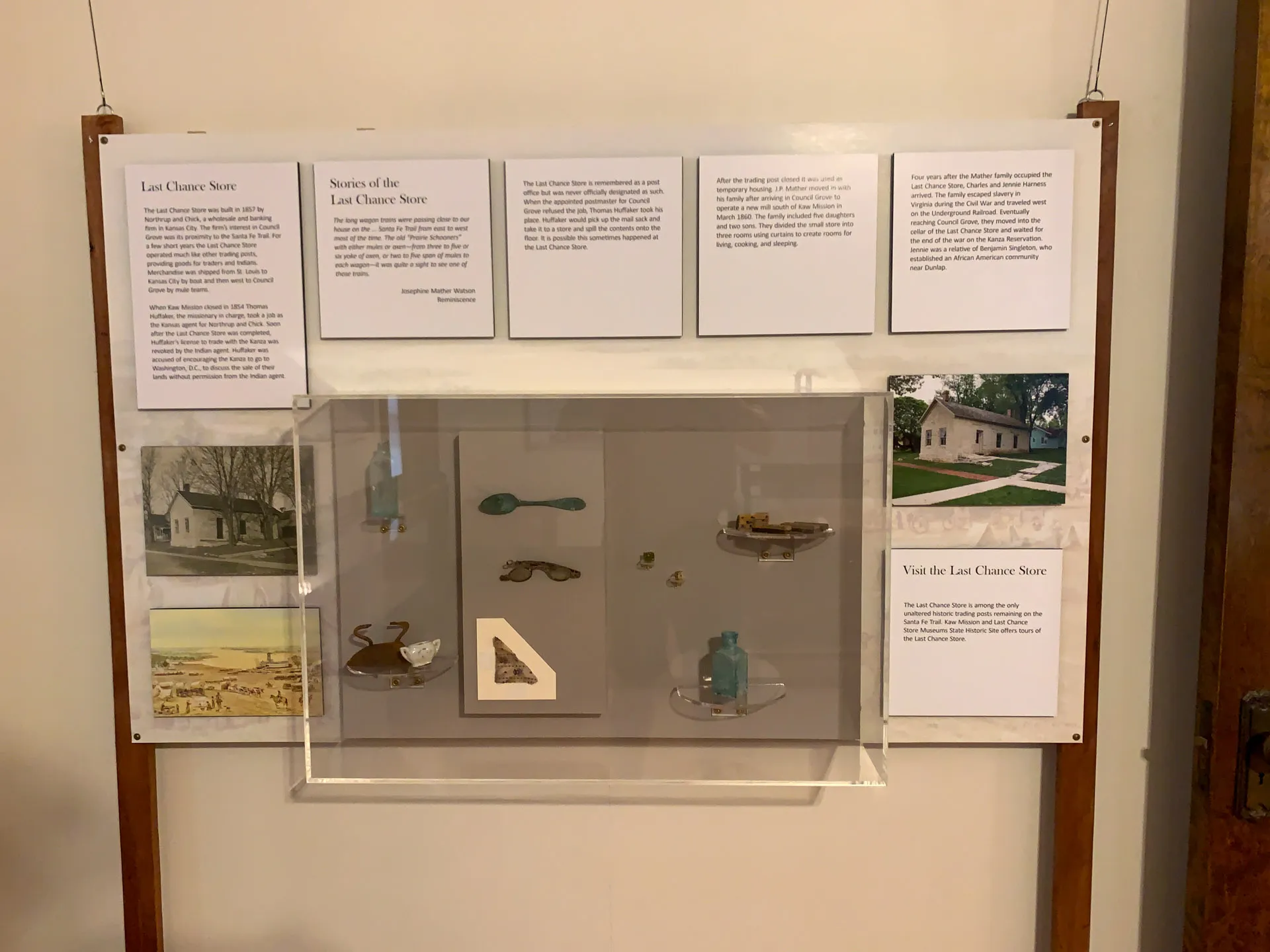
A museum display features a wooden frame with six informational panels about the Last Chance Store. Below, a clear case contains historical artifacts, including utensils, a blue glass bottle, and assorted items. An image of the store is displayed in the bottom right panel.
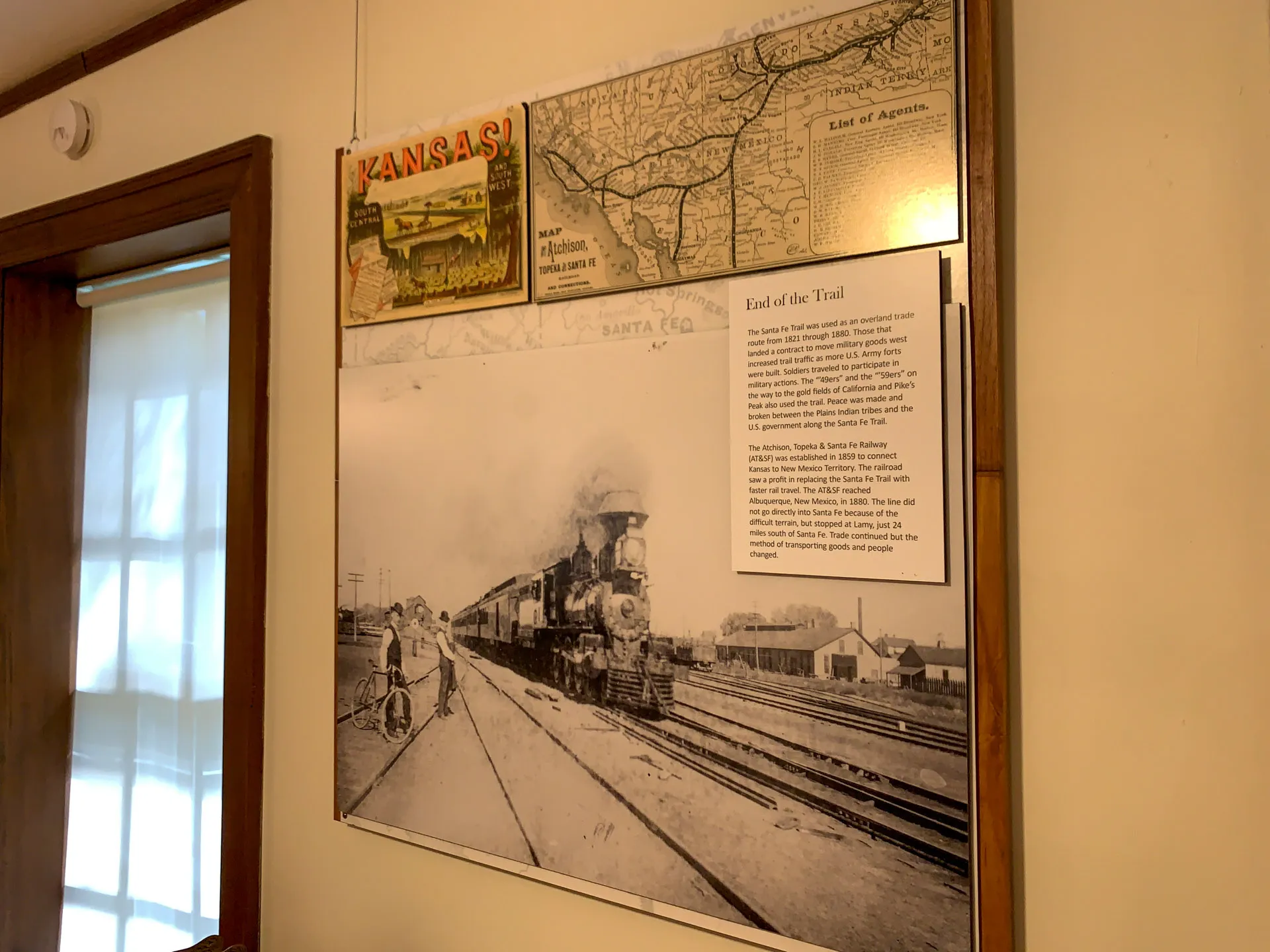
Wall display featuring a historic black-and-white photo of a steam locomotive at a station. Above it are map sections, a vintage Kansas postcard, and a text panel titled "End of the Trail" describing the railroad's history. The display is in a warmly lit, wooden room.
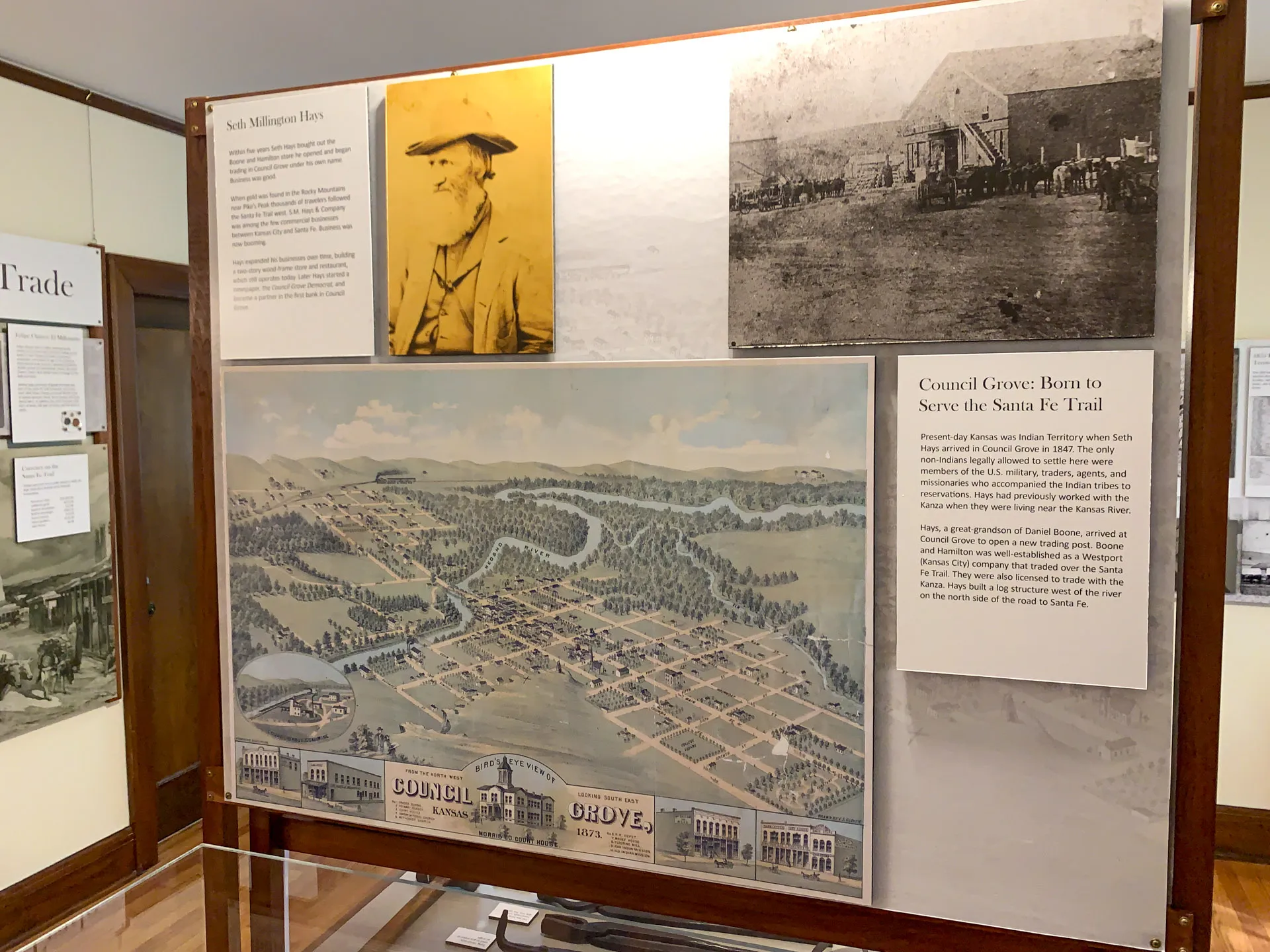
Exhibit display featuring a map of Council Grove, Kansas, with labeled streets and buildings. Includes an old photograph of Seth Millington Hays, a historical description, and a black-and-white photo of settlers and covered wagons. The display is contained within a wooden frame.
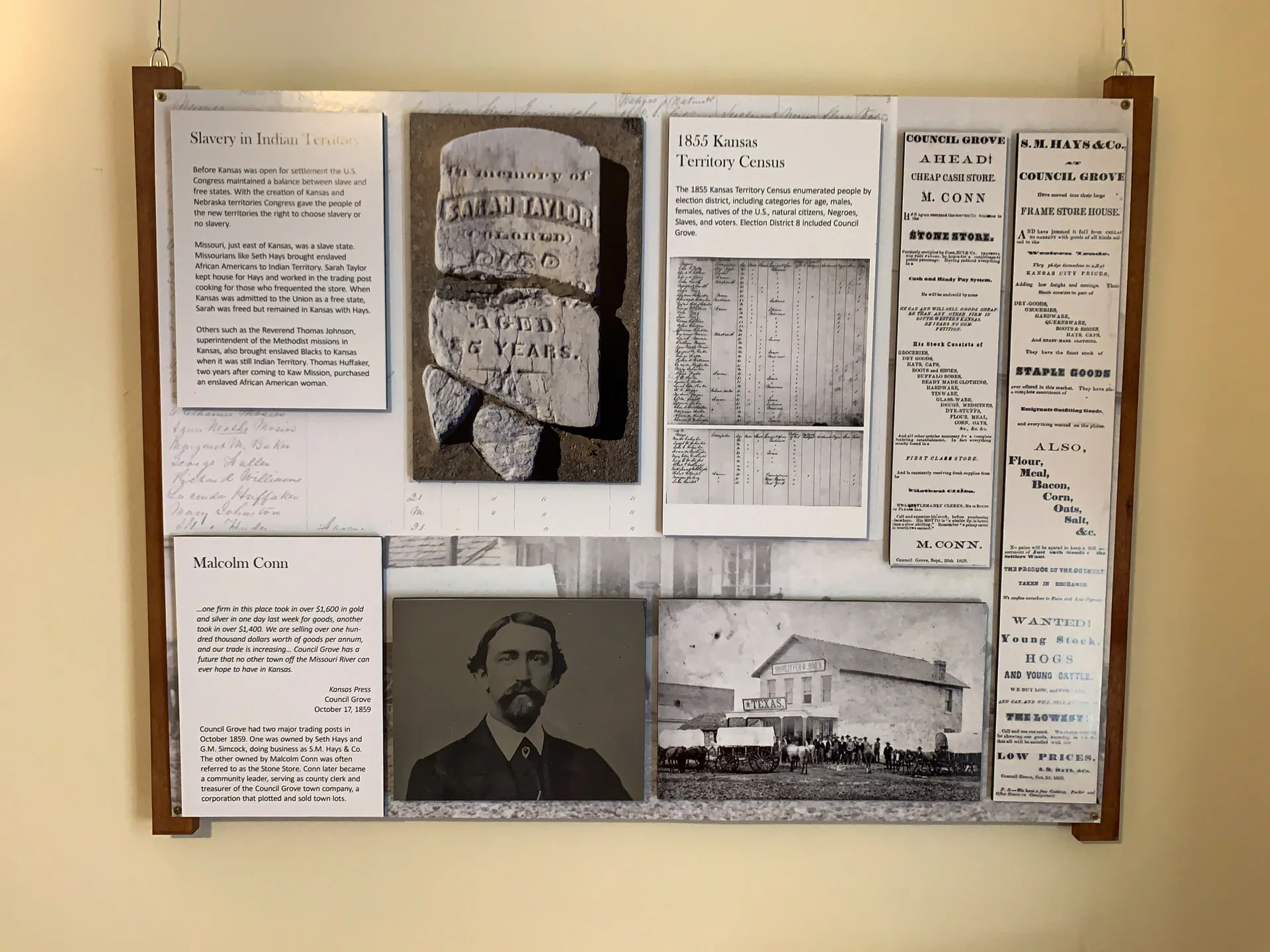
A historical display board features various documents and images. It includes a gravestone photo, text about 1855 Kansas Territory Census, and a section on Malcolm Conn. There's a black-and-white portrait of a man, alongside an old photograph of a wagon and people outside a building.
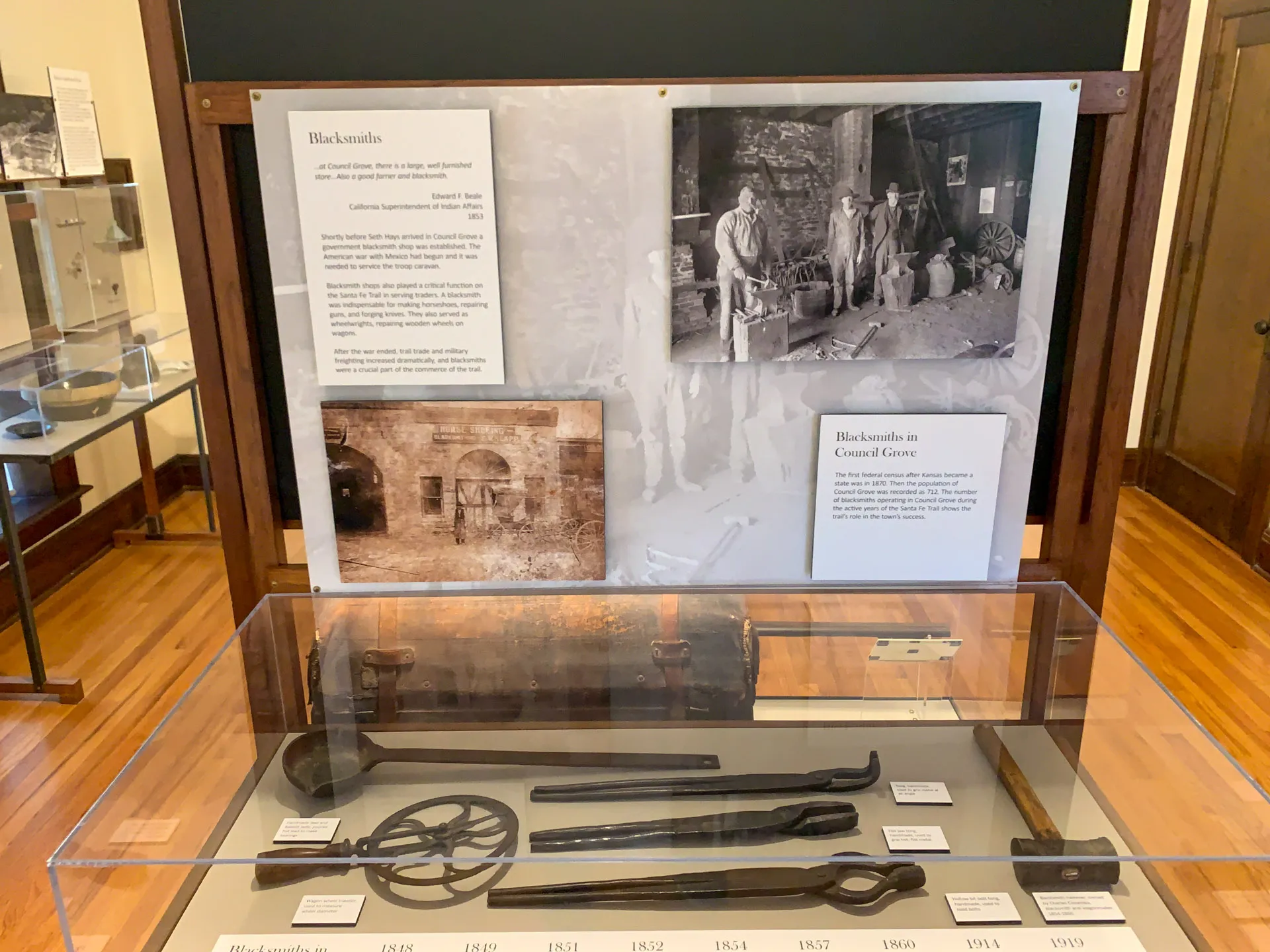
A museum exhibit displays blacksmithing tools, including tongs, a circular tool, and a long wrench, encased in glass. Above are informational panels and historical black-and-white photos of blacksmiths at work. The exhibit is on a polished wooden floor.
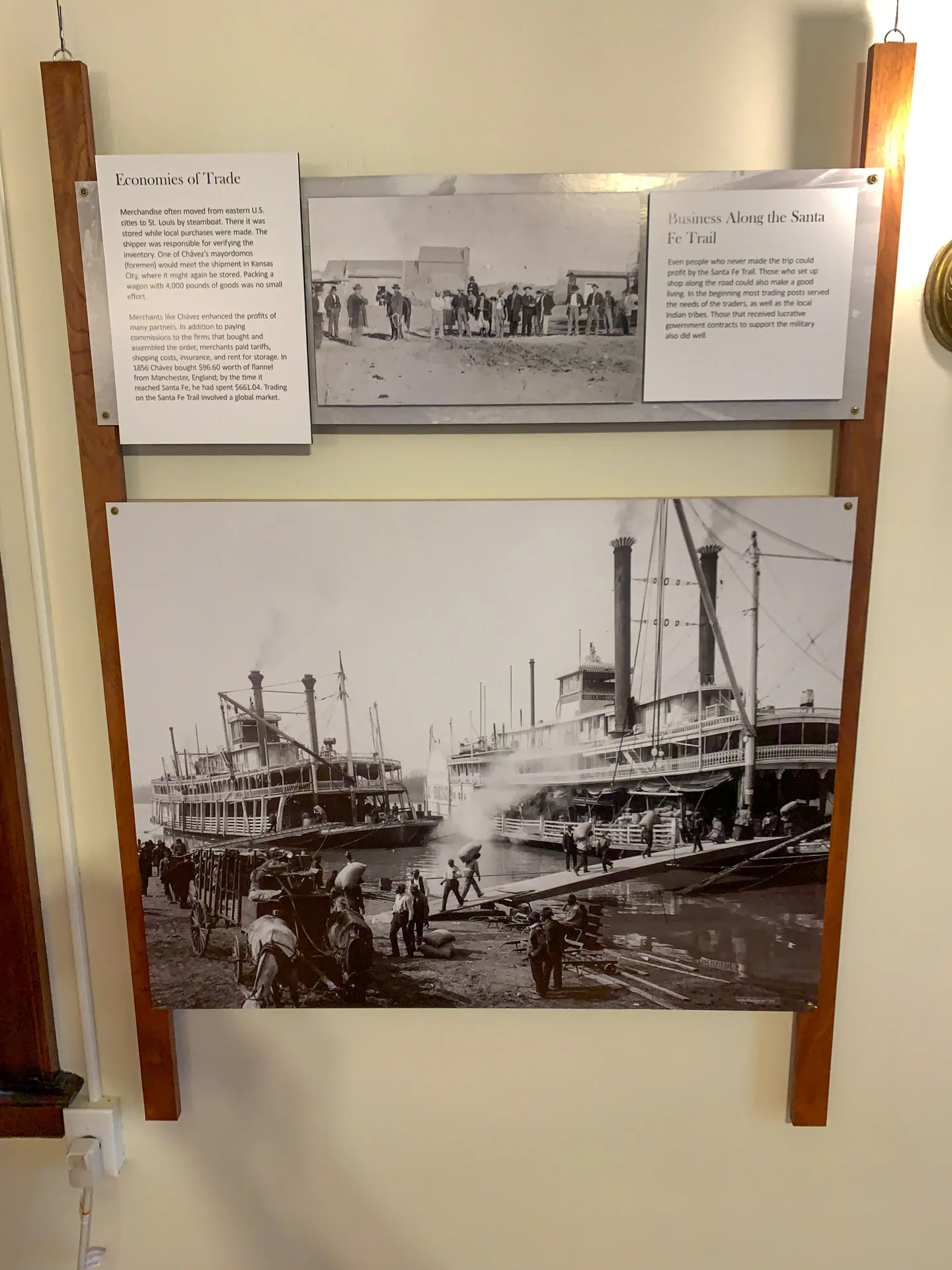
Museum display featuring historical photographs. The top section describes "Economies of Trade" and "Business Along the Santa Fe Trail," with a small image. Below is a large black-and-white photo of people and steamboats at a busy river dock, depicting 19th-century commerce.
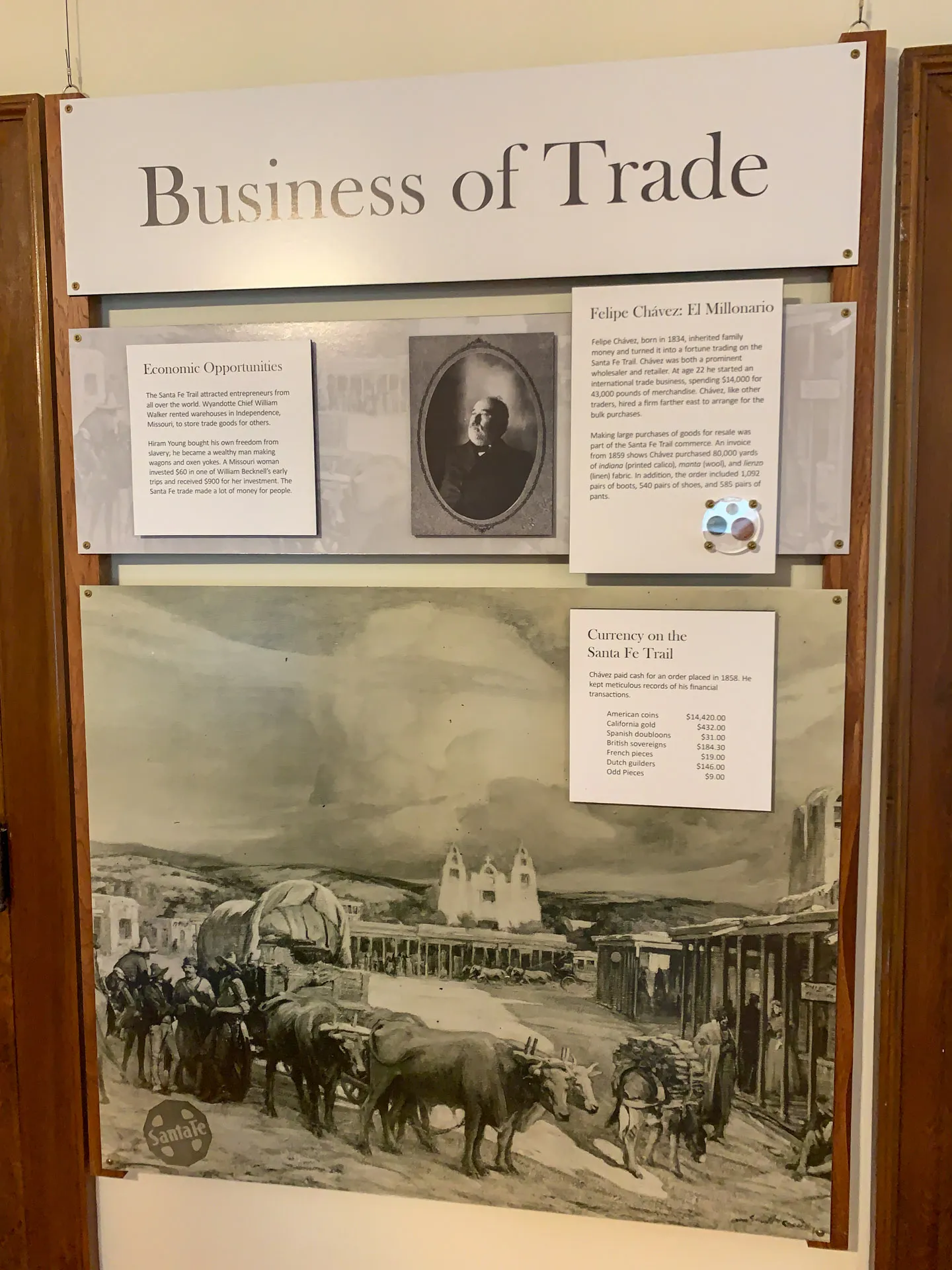
A historical display titled "Business of Trade" features three panels. The top panel discusses economic opportunities, the middle shows a portrait of Felipe Chávez with a biography, and the bottom displays a historic trade scene with oxen and carts near buildings labeled "Santa Fe.
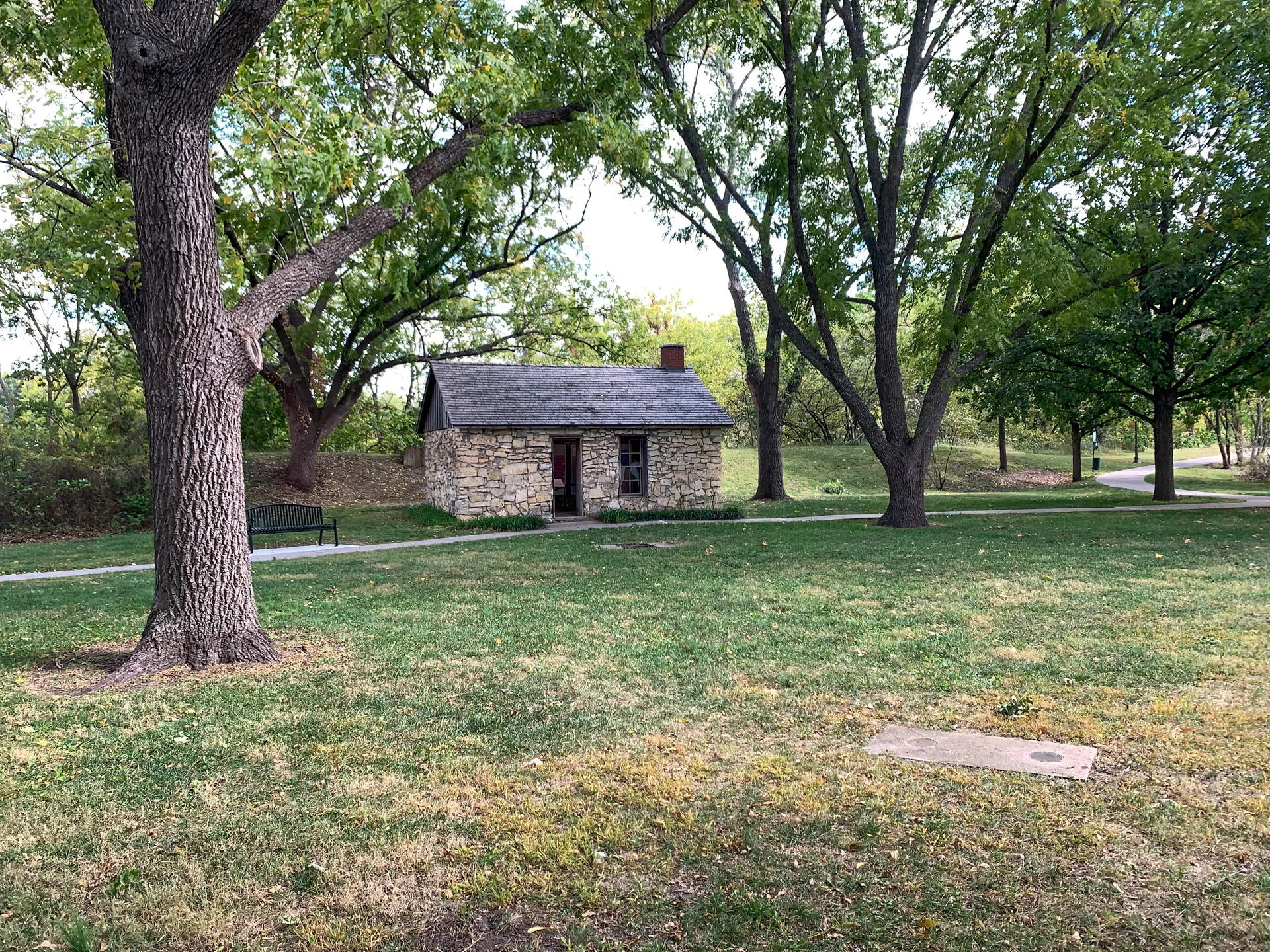
A small stone building with a gray roof is nestled among green trees in a park. A pathway leads to its wooden door. There's a bench on the left side of the path. The surrounding grass is green with patches of brown. The scene is peaceful and bathed in natural light.
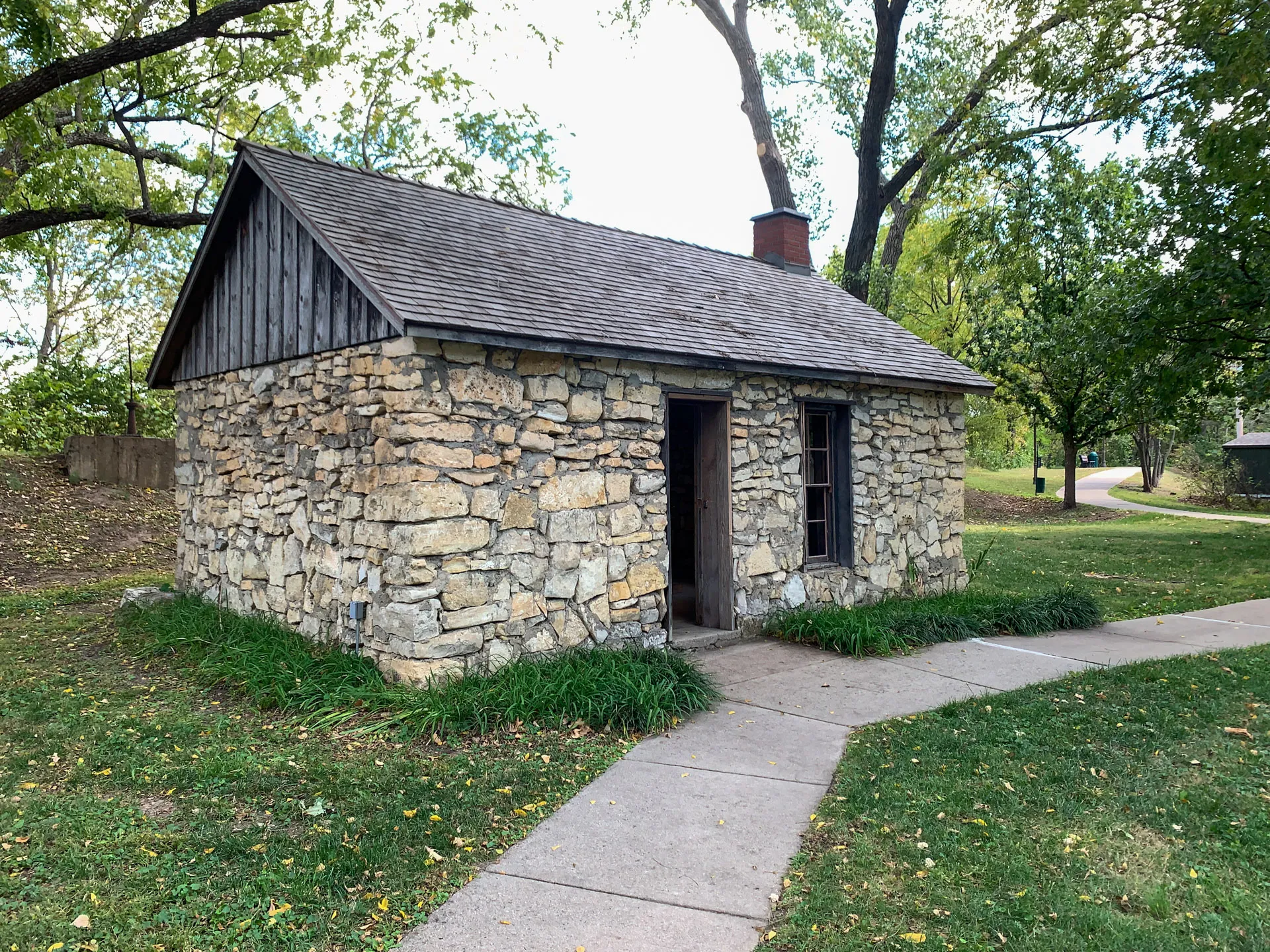
A small stone cabin with a wooden gabled roof stands in a grassy area. The cabin has a chimney, two windows with dark frames, and a wooden door. A concrete pathway leads to the entrance. Tall trees surround the building, with some leaves scattered on the grass.
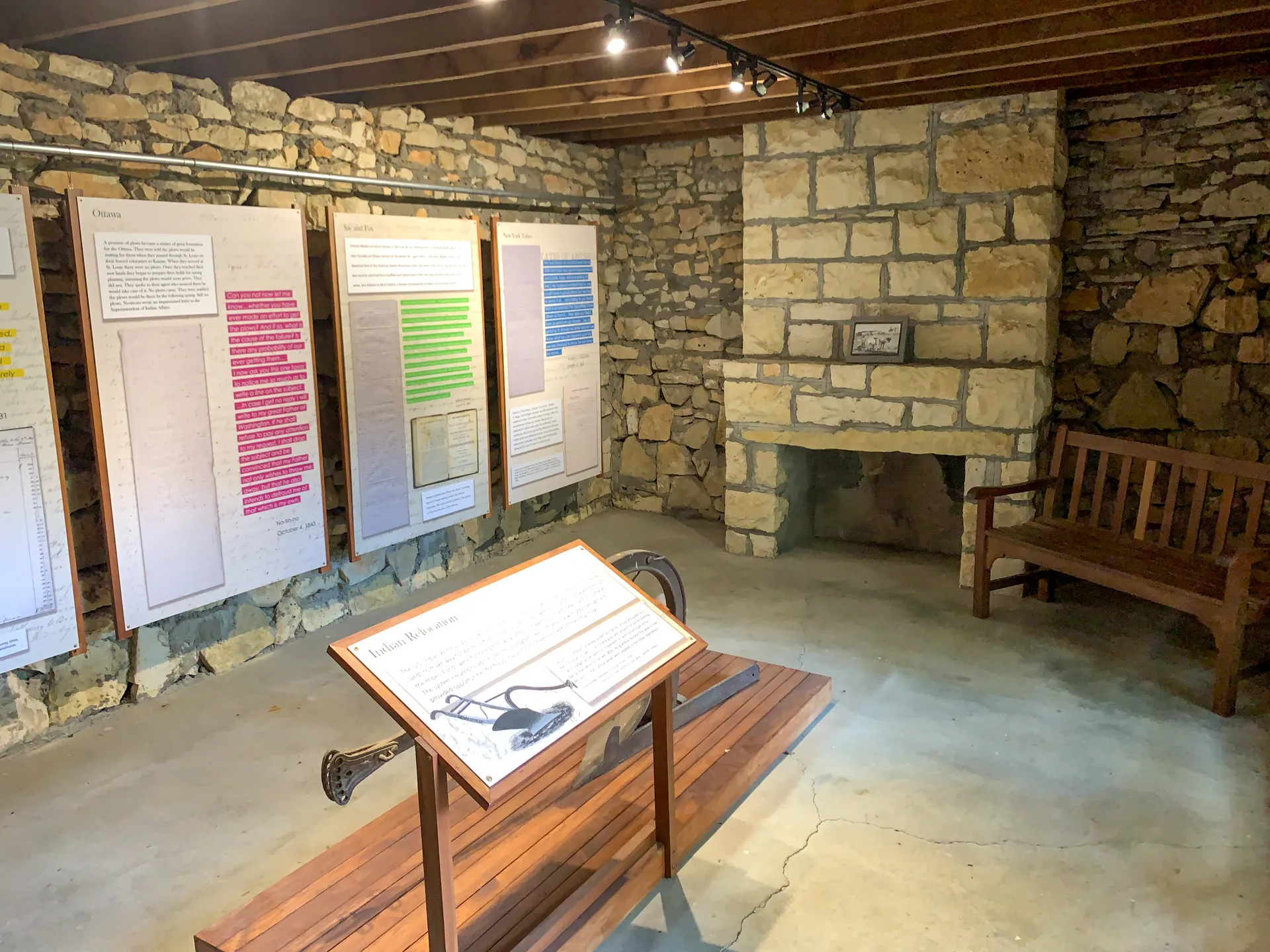
A museum exhibit features several large text panels with historical information displayed on stone walls. A wooden bench sits on the right, and a central stand holds an artifact with descriptive text. The room has a rustic stone aesthetic with overhead lighting.
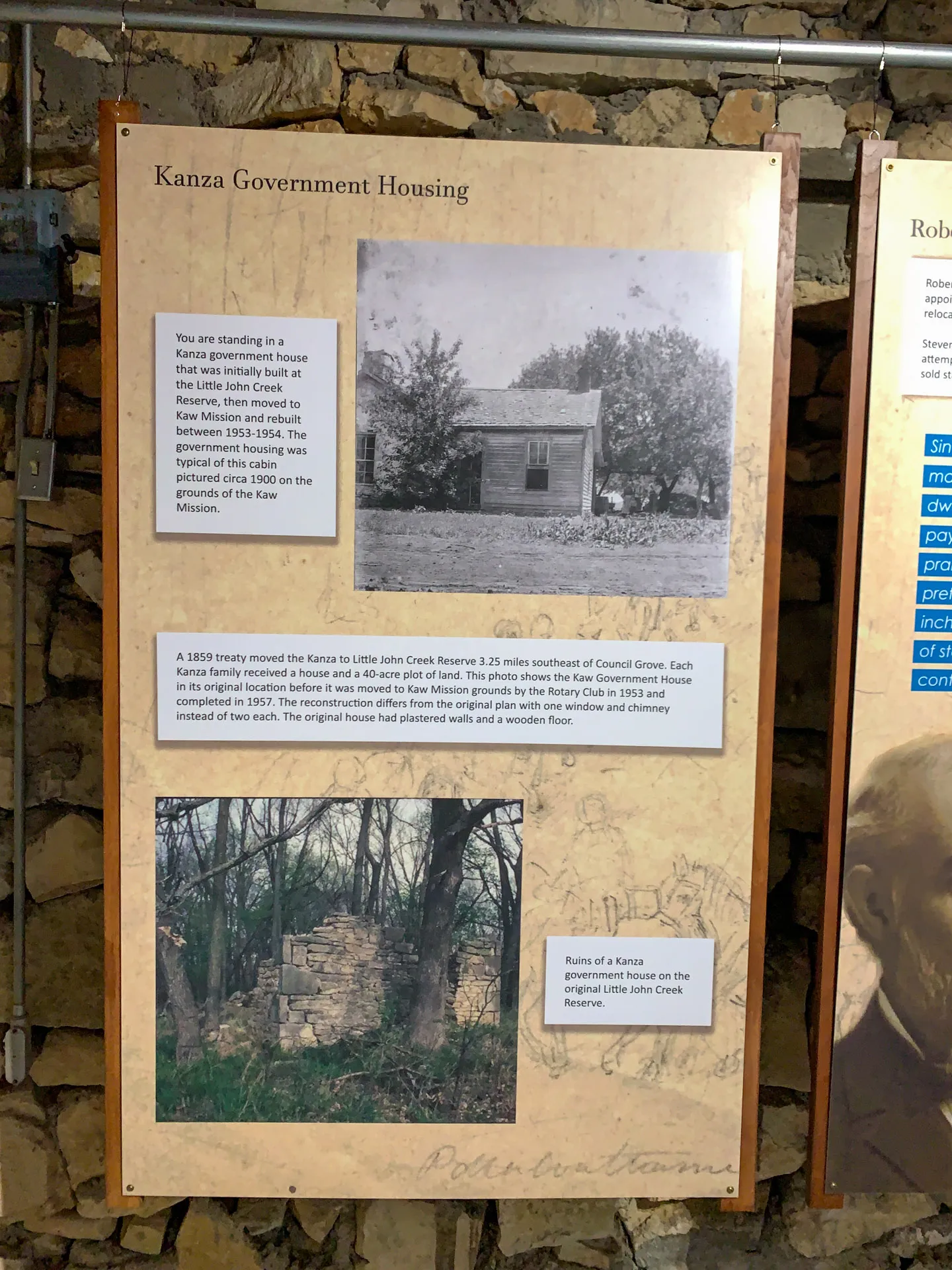
A museum display board titled "Kanza Government Housing" features two black and white photos. The top image shows a 19th-century house with a wooden fence. The bottom image depicts ruins of a stone structure. Text describes the history of Kanza housing on the Little John Creek Reserve.
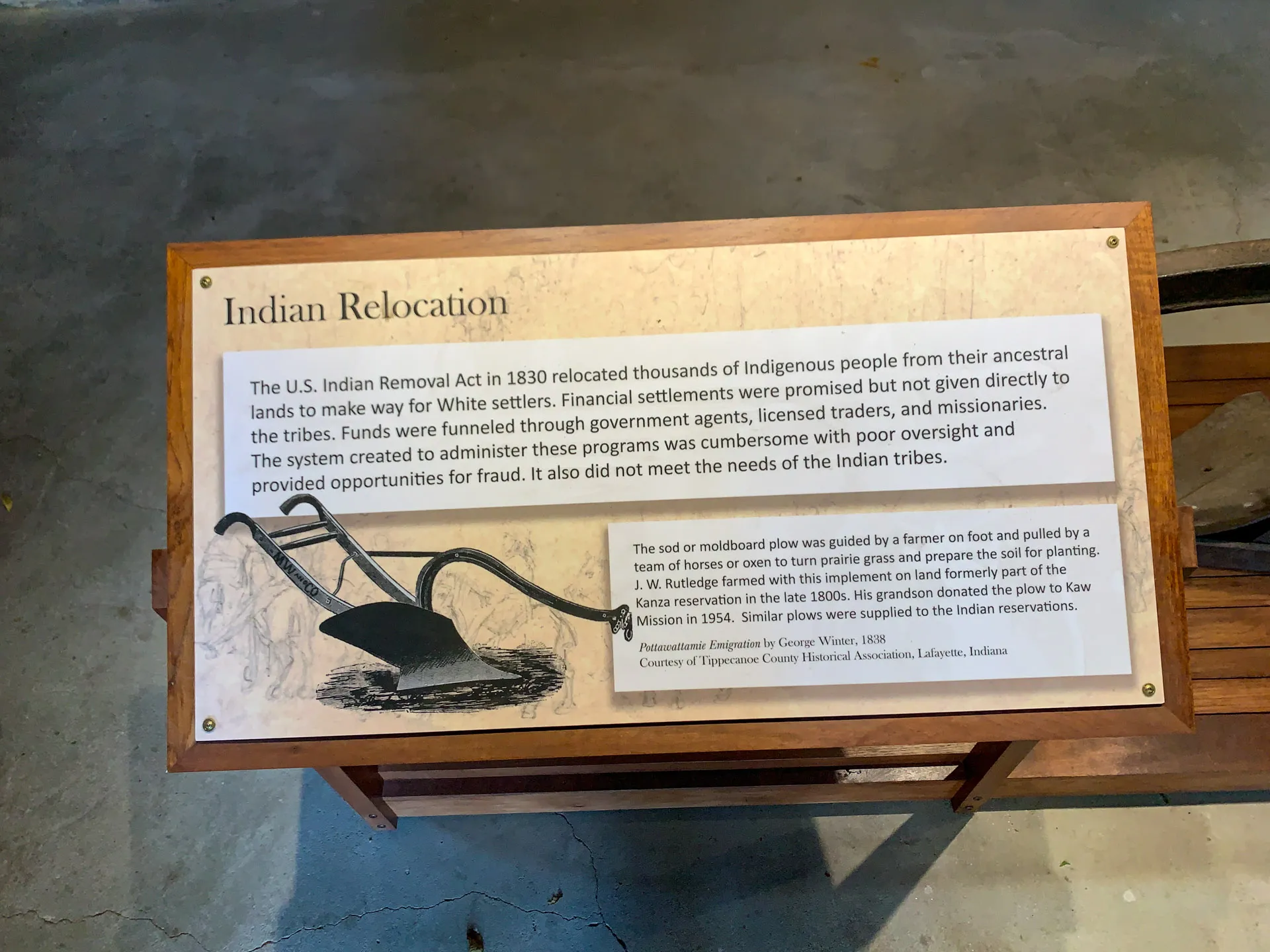
A wooden display featuring an informational plaque titled "Indian Relocation." The plaque describes the 1830 Indian Removal Act, noting relocation issues, financial settlements, and governmental mismanagement. Below is an illustration of a traditional plow. A bench is partly visible.
Dive Into More of Shea's Related Content
From: Kansas